Sharadiya Durga Puja, the biggest religious festival of the Bangalee Hindu community, is knocking at the door, with the festivities set to begin formally in Bangladesh with Maha Shashthi Puja on October 16 this year.
However, Durga Puja did not become the principal festival of Bangalee Hindus overnight. Over several centuries, it evolved from a Hindu religious ritual into one of the most important expressions of Bengali culture, identity, art, community and collective celebration.
Its history is closely linked to Bengal's social and cultural evolution, the rise of wealthy landowning families, the growth of community-organised pujas and the distinctive Bengali imagination of Goddess Durga—not only as a mighty slayer of evil but also as a daughter returning to her parental home with her children.
UNESCO Recognition: A Global Cultural Milestone
The UNESCO recognition of Durga Puja is a milestone in the festival's history.
On December 15, 2021, during its 16th session in Paris, the UNESCO Intergovernmental Committee officially inscribed "Durga Puja in Kolkata" on the Representative List of the Intangible Cultural Heritage of Humanity.
The organisation highlighted the festival's combination of religion, art, craftsmanship, public participation and community collaboration.
This made it the first festival in Asia to receive this specific distinction. This recognition reflected something the festival had long demonstrated: its cultural significance extends well beyond the rituals of worship.
The religious roots: Durga arrives in Bengal
Goddess Durga is worshipped across many parts of India, but Bengal developed a distinctive tradition around her autumnal worship, known as Sharadiya Durga Puja.
The religious foundation of the festival lies in Hindu traditions in which Durga defeats Mahishasura, the buffalo demon, symbolising the triumph of divine power over evil. In Bengal, however, this story acquired an especially intimate, familial meaning.
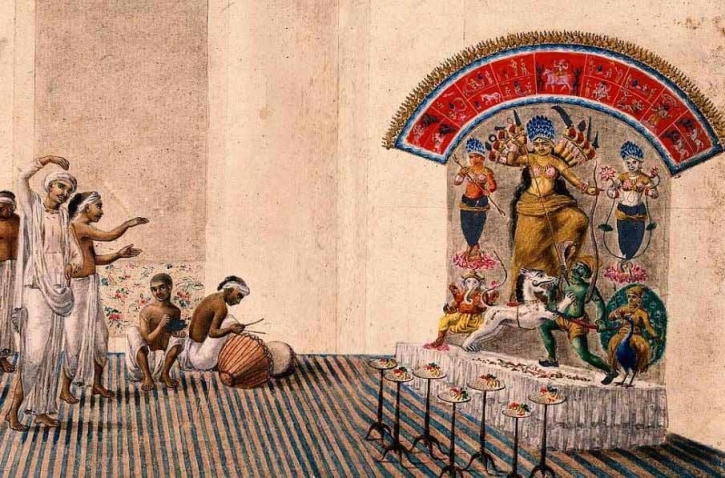
In the Bengali cultural imagination, Durga is also Uma, the beloved daughter of Himalaya and Menaka, who returns to her parental home for a few days every year. Her children—Lakshmi, Saraswati, Kartik and Ganesh—accompany her in the familiar Bengali representation of the goddess.
This combination of mythology, motherhood, family reunion and homecoming has helped make the festival emotionally meaningful far beyond the formal rituals of worship.
Zamindars made Durga Puja grand
In the late sixteenth and seventeenth centuries, wealthy zamindars and royal families helped establish elaborate autumnal Durga Puja celebrations in Bengal.
One prominent figure associated with the early grandeur of the festival was Raja Kangsa Narayan of Taherpur, in present-day Rajshahi district of Bangladesh. His name is linked to an early grand autumnal puja, although the precise origins of Bengal's earliest elaborate Durga Puja celebrations remain debated.
The Sabarna Roy Choudhury family is known for its Durga Puja tradition dating to 1610, while Raja Nabakrishna Deb's celebrated puja at Shobhabazar Rajbari in Calcutta began in 1757.
These aristocratic celebrations were religious occasions, but they also served as displays of wealth, prestige and social influence. Music, feasts, theatrical performances and elaborate decorations transformed the puja into a major social event.
A crucial development was that Durga Puja became a grand Bengali social occasion, rather than remaining simply a religious ceremony.
From landlords' courtyards to a people's festival
For a long time, the grandest pujas were organised by wealthy families. Ordinary people could participate in religious life, but they did not necessarily have equal access to the private celebrations of the elite.
That began to change with the rise of barowari puja, in which communities organised worship collectively with contributions from multiple people.
A widely repeated account traces this tradition to Guptipara in Hooghly, where a group of friends organised a puja together. Historical accounts differ on whether the pioneering celebration took place in the 1760s or around 1790. By the early twentieth century, public pujas were becoming increasingly important in Calcutta.
The term sarbojanin, meaning roughly ‘for everyone’, captured the broader aspiration of community-organised worship.
This transformation changed the festival in three important ways.
Participation: People could contribute money, volunteer and help organise celebrations.
Community: A neighbourhood could celebrate together, regardless of individual wealth.
Public culture: Streets, courtyards and, eventually, elaborate pandals became shared spaces for worship and social gatherings.
Durga Puja increasingly became a celebration belonging to the community rather than to a single household.
The festival became a symbol of Bengali identity
Bengali identity finds expression in language, literature, food, music, family relationships and shared cultural traditions. Durga Puja gradually brought many of these elements together in an annual celebration.
Its distinctive features include:
Mahalaya: For many Bengalis, the recitation of Mahishasuramardini marks the emotional beginning of the festive season.
Dhak: The distinctive rhythms of Bengali drums create an unmistakable festive atmosphere.
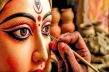
Pandal and pratima: Sculptors and artisans transform clay into elaborate images, while designers create temporary architectural spaces for worship and celebration.
Adda, food and new clothes: Meeting friends, visiting relatives, sharing meals and dressing up make the festival an integral part of everyday social life.
Bijoya Dashami: The farewell to the goddess evokes the emotions of reunion and separation.
These traditions give Durga Puja a distinctly Bengali character, even though Goddess Durga is worshipped throughout India.
The festival also acquired broader cultural significance during the colonial era, when Bengali public life, literature, art and ideas of collective identity were undergoing significant changes. Religious gatherings could provide spaces for expressing a sense of belonging, although the history of Durga Puja cannot be reduced to nationalism alone.
Durga as the daughter returning home
Why does Durga Puja feel so personal to Bengalis? One answer lies in the Bengali cultural imagination of the goddess. In Bengal, Durga is not only the warrior who defeats Mahishasura. She is also Uma, the daughter who returns to her parents' home from her husband's household. Her visit is brief, so her departure brings sadness.
The story echoes familiar Bengali experiences of family, homecoming, separation and affection.
The festival therefore operates on two emotional levels. Religiously, devotees worship the divine mother. Culturally, people celebrate the return of a beloved daughter and the reunion of families and communities.
This emotional connection helps explain why Durga Puja remains meaningful even to many Bengalis whose participation extends beyond formal religious observance.
From a regional celebration to a modern cultural phenomenon
During the twentieth century, public pujas increasingly became platforms for artistic experimentation, community organisation and public celebration. Today, they bring together sculptors, painters, architects, lighting designers, musicians, volunteers and visitors.
The tradition has also travelled with Bengali communities across India and around the world. In Bangladesh, Durga Puja remains a major religious and cultural festival for Bangalee Hindus, with local traditions shaped by the country's own history and social context.
Durga Puja did not become the principal festival of Bangalee Hindus through a single royal decree, religious reform or historical event. Rather, it evolved over centuries through collective participation and cultural transformation.
It remains a Hindu religious festival with a distinctly Bengali cultural identity. It is an occasion of sacred worship, but also a celebration of homecoming, creativity, community and belonging.
That is why, for so many Bengalis, the arrival of Durga is experienced not merely as the arrival of a goddess, but also as the arrival of the festive season itself.