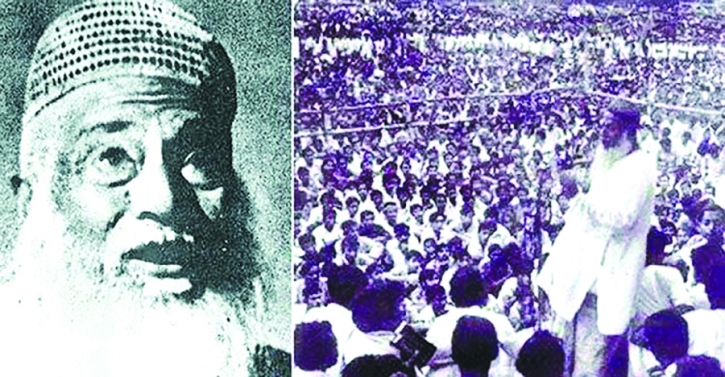
The Farakka Long March is remembered as one of the most significant mass political movements in the history of Bangladesh. Led by Maulana Abdul Hamid Khan Bhashani. The movement was organized on 16 May 1976 to protest the diversion of the Ganges water by India through the Farakka Barrage. The march symbolized not only a struggle for water rights but also the assertion of Bangladesh’s sovereignty and environmental security after independence. The roots of the Farakka dispute go back to the construction of the Farakka Barrage by India in the state of West Bengal. The barrage was designed primarily to divert water from the Ganges River into the Hooghly River in order to improve the navigability of the Kolkata port. Although India considered the project economically necessary, Bangladesh feared that the withdrawal of water upstream would severely affect the downstream flow of the Ganges, known in Bangladesh as the Padma River.
Bangladesh, a lower riparian country, depends heavily on river water for agriculture, fisheries, transportation, and ecological balance. After the operation of the barrage began, many experts and local people observed a decline in water flow during the dry season. Large parts of southwestern Bangladesh faced drought-like conditions. Rivers became shallow, crop production suffered, fisheries declined, and salinity increased in coastal areas. Environmental concerns quickly turned into a national political issue. During the mid-1970s, Bangladesh was passing through a difficult political period marked by economic hardship, food shortages, and political instability. In this context, the Farakka issue became deeply emotional for the people, as it touched directly on their livelihood and national dignity.
At this critical moment, Maulana Abdul Hamid Khan Bhashani emerged as the leading voice against the Farakka Barrage. Popularly known as “Majlum Jananeta” or the “Leader of the Oppressed,” Bhashani had long been respected for his pro-people politics and anti-imperialist stance. Even in his old age, he remained highly influential among peasants, workers, and ordinary citizens.
Bhashani believed that the reduction of Ganges water threatened the survival of millions of Bangladeshis. He accused India of ignoring the legitimate rights of Bangladesh over the shared river water. At the same time, he criticized the Bangladeshi government for what he saw as a weak diplomatic response. To mobilize public opinion and draw international attention to the crisis, Bhashani announced a historic “Long March” towards the border area near Farakka. On 16 May 1976, thousands of people from different parts of Bangladesh joined the Farakka Long March under Bhashani’s leadership. The march moved toward Kansat in Chapai Nawabganj, near the Indian border. Participants included farmers, laborers, students, political activists, and common villagers. The atmosphere of the march was highly emotional and patriotic. Protesters carried banners and shouted slogans demanding fair distribution of river water. The Long March was peaceful but politically powerful. It demonstrated the deep concern of the Bangladeshi people regarding water security and environmental survival. Bhashani’s speech during the gathering warned that denying Bangladesh its rightful share of water could lead to severe humanitarian consequences.
Although the march did not physically cross into India, it created enormous political pressure and attracted international media attention. It became one of the earliest large-scale environmental and water-rights movements in South Asia. The Farakka Long March had a significant impact on Bangladesh’s national politics and foreign policy. It forced the government to address the issue more strongly at the diplomatic level. The movement also helped unite people across political and ideological divisions around a common national cause. Internationally, the march highlighted the importance of transboundary river management. The issue of equitable sharing of international rivers became more widely discussed in diplomatic circles and international forums.
Although the immediate problem was not solved, the movement contributed to future negotiations between Bangladesh and India over Ganges water sharing. After years of talks, the two countries eventually signed the Ganges Water Sharing Treaty in 1996. Many historians believe that the Farakka Long March played an important role in keeping public pressure alive and shaping the long-term discourse surrounding the issue. The Farakka movement was not merely political; it was also environmental in nature. Today, environmental historians often describe it as one of the pioneering ecological protest movements in South Asia. The concerns raised by Bhashani in 1976 later proved to be highly relevant. Reduced river flow contributed to riverbed siltation, declining biodiversity, loss of fish species, and increasing salinity in southwestern Bangladesh. Environmentalists continue to discuss the long-term ecological effects of upstream water diversion. Thus, the Farakka Long March can also be viewed as an early struggle for environmental justice and sustainable resource management. The Farakka Long March remains a symbol of people’s resistance and national rights in Bangladesh. Every year, political parties, social organizations, and progressive groups observe Farakka Long March Day on 16 May through discussions, rallies, and commemorative programs. The Farakka Long March of 1976 occupies a unique place in the political and environmental history of Bangladesh. Led by the veteran leader Maulana Abdul Hamid Khan Bhashani. the movement was a bold protest against the unequal distribution of the Ganges water through the Farakka Barrage. More than a political demonstration, it was a movement for survival, justice, and sovereignty. The march reflected the anxieties of a newly independent nation struggling to protect its natural resources and the rights of its people. Even decades later, the Farakka issue remains relevant in discussions on regional cooperation, river diplomacy, and environmental sustainability. The Long March continues to inspire those who believe in the power of peaceful mass movements to defend national and human interests.
(The writer is a staff correspondent of The South Asian Times)