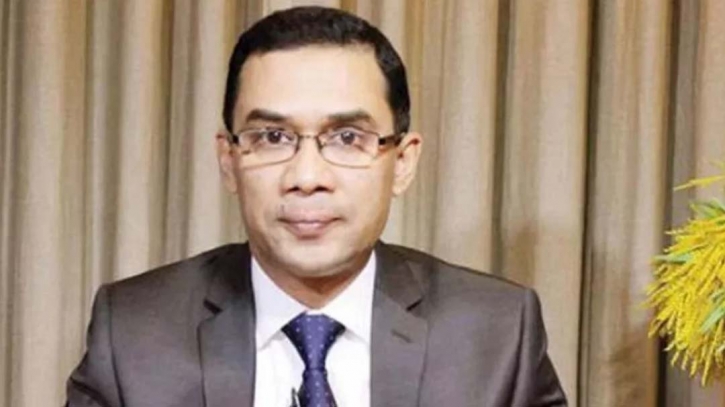
BNP acting chairman Tarique Rahman has been staying in the UK since his release from jail in 2008 and has been sentenced in several cases in absentia in Bangladesh. He attends party meetings and public rallies virtually, while the BNP media wing regularly uploads his video speeches on YouTube and other social media sites.
For the first time in years, he recently gave an interview to a media outlet. And it is none other than The Diplomat, the influential magazine based in the US. The piece was published on December 18.
An Indian journalist named Snigdhendu Bhattacharya, from Kolkata, interviewed the BNP leader, who is fugitive as per the law.
Bangladesh does not have an extradition treaty with the UK.
Curiosity within BNP
Following a 2015 court order, the media outlets in Bangladesh stopped publishing or relaying speeches and remarks by Tarique Rahman, the eldest son of BNP Chairperson Khaleda Zia, who has also been jailed and faces trial in many cases, mostly for graft.
For this reason, no Bangladeshi media outlet ran his interview despite publishing it in a renowned global magazine.
Ever since the magazine’s publication, curiosity started to deepen among BNP leaders and activists of different levels as to why he gave the interview after these many years, and that too before the January 7 general election.
They are keen to know the exact reason for the Kolkata-based journalist interviewing Tarique, who has long been making social media statements and attending UK meetings.
So, now, the interview begs the question: Did Tarique try to make any gains through that?
Who is Snigdhendu?
He has written about India’s politics, history, data, environment, human rights, and culture since 2005. A former special correspondent of the Hindustan Times, Snigdhendu writes for several Indian media portals, including The Wire, Scroll.in, Firstpost, and some international news outlets.
He takes a particular regional interest in eastern and northeastern India and Bangladesh. He has two books of political nonfiction published by HarperCollins India -- Mission Bengal: A Saffron Experiment (2020) and Lalgarh and the Legend of Kishanji: Tales from India’s Maoist Movement (2016).
He is a recipient of EJN’s Asia-Pacific Climate and Environmental Story Grant.
Interesting findings
An investigation into the issue shed light on some interesting subjects.
The significant finding is that he tried to draw the attention of the West, mainly the US, and convince them why his party boycotted the forthcoming polls. Sources said that Snigdhendu made him agree to give the interview by defending his party’s decision about the election.
Dhaka-based BNP Senior Joint Secretary General Ruhul Kabir Rizvi and the UK unit BNP leader MA Maleque played a crucial role in Snigdhendu's interview with Tarique.
Bangla Tribune has confirmed the matter by talking to several sources in Dhaka and London.
As mentioned, Snigdhendu interviewed Rizvi for Al Jazeera in late November. In the interview published on November 29, Rizvi explained why he called the January 7 election "farcical" and boycotted it.
Soon afterward, Snigdhendu requested that Rizvi arrange an interview with Tarique.
How the process unfolded
The Indian journalist informed Rizvi that The Diplomat would interview if Tarique agreed.
Even though the acting BNP chief was primarily in a fix, he decided to go ahead in a few days, thinking the US would get a clear message from his interview.
With the US showing “intense interest” and warning of a separate visa policy over the 12th general election of Bangladesh, Tarique did not miss out on the chance to get closer to Washington, the sources said.
After getting Tarique’s consent, Snigdhendu was told to email him a questionnaire.
Many queries in the questionnaire were avoided. But as Snigdhendu was still eager to get answers to some questions, he requested to talk to Tarique over the phone. The BNP leader accepted the request too.
It can be summed up that the interview got a “proper and complete shape” through a series of communications among Dhaka, Kolkata, and London.
When asked why precisely an Indian journalist took Tarique’s first interview in years, a BNP leader familiar with the development, preferring anonymity, said: “It has nothing to do with India.
“Tarique agreed to give the interview in a bid to directly convey our message (about the election) to the West. He would certainly not have rejected (the offer to do so) if approached even by a Polish or Pennsylvanian journalist working for The Diplomat,” he said.