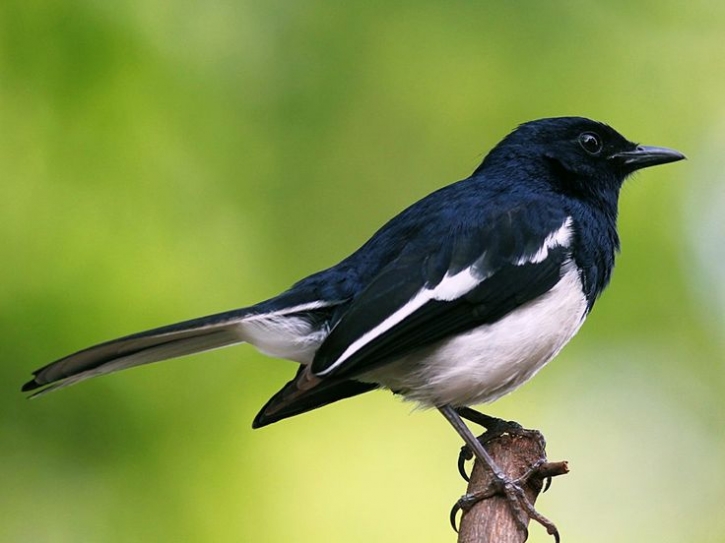
Bangladesh's national bird, the Doyel is facing a severe existential crisis in its own homeland. Known for its sweet whistling and lively nature, this beloved bird is rapidly vanishing from the country's familiar natural landscape.
Once upon a time, this small bird would awaken the nature of Bengal with its melodious whistle at the break of dawn. With its striking black-and-white plumage and restless demeanor, the Doyel was an inseparable part of Bengal's timeless nature and folk culture.
Today, both that familiar melody and the bird itself are fast disappearing from the wild, making sightings increasingly rare. The Doyel has now become a threatened species across the country.
According to environmentalists and ornithologists, unplanned urbanization, indiscriminate deforestation, and the excessive use of pesticides in croplands have caused an alarming decline in the population of our national bird. The widespread application of pesticides destroys insects and pests—the Doyel's primary food source—leading to acute food shortages and premature deaths.
To today's children and teenagers, the Doyel is merely a still image in a textbook.
As greenery vanishes into concrete jungles, this once-familiar bird has become a stranger to the new generation. While today's children memorize "Doyel is our national bird" for general knowledge exams, they barely ever see one in real life.
Following independence, eminent zoologists and researchers selected the Doyel as the national bird from among countless species based on five key considerations.

First, the Doyel was easily spotted in almost every region of the country.
It roamed freely across villages, cities, hills, and forests, making it a familiar and beloved bird to people from all walks of life.
Second, during the selection process, it was noted that no other country in the world had adopted the Doyel as its national bird. This made it a unique and exclusive symbol of Bangladesh on the international stage.
Third, forest birds generally cannot survive in cities, and urban birds struggle to adapt to forests. However, the Doyel thrives equally well in bustling human settlements and secluded woodlands.
Fourth, the Doyel possesses an exceptionally sweet singing voice. Its melodious morning whistle captivates listeners, while its black-and-white feathers and playful habit of hopping with a raised tail give it a distinct aesthetic charm.
Fifth, the Doyel is primarily an insectivorous bird. By feeding on harmful crop pests, it benefits farmers and plays a vital role in maintaining ecological balance.
In honor of this national bird deeply woven into Bengali heritage, the iconic Doyel Chattar was built in the capital city of Dhaka. Additionally, its image is featured on the Bangladeshi two-taka banknote, immortalizing its status in national life.

Although it is the national bird of Bangladesh, the Doyel's habitat is not confined to this territory alone.
According to BirdLife International, the species is found in about 15 other countries across South and Southeast Asia.
Measuring about 20 centimeters in length and weighing roughly 40 grams, the male Doyel has glossy black upperparts and throat with a white belly and distinct white patches on both wings.
In contrast, the female has grayish upperparts and throat, with a duller, off-white belly.
The breeding season of the Doyel spans from March to July. During this period, they build nests using grass and leaves inside tree hollows, wall crevices, or gaps in pipes.
They lay four to five greenish eggs, which hatch within 12 to 13 days.

In South Asia, the Doyel is widely distributed across India, Pakistan, Nepal, Bhutan, and Sri Lanka. It is also abundant in Southeast Asian nations including Myanmar, Thailand, Malaysia, Singapore, Indonesia, Brunei, Cambodia, Laos, Vietnam, and the Philippines, as well as southern China and Taiwan in East Asia. Depending on the region, it is known by various local names—such as 'Dahiyal' in India, 'Polkichcha' in Sri Lanka, and 'Binla' in southern Thailand.
Unplanned urbanization is destroying Doyel habitats in both rural and urban areas. The reckless felling of old trees and bamboo groves in villages, coupled with the exponential rise of high-rise buildings in cities, is depriving the bird of its natural nesting environments and safe breeding grounds.
Furthermore, harmful invisible radiation emitted from thousands of mobile phone towers across the country disrupts the birds' internal navigation systems and damages embryos inside their eggs, drastically reducing their reproduction rates.
Despite existing laws, poachers in remote areas continue to trap, cage, and trade Doyels, posing another major obstacle to their free breeding.

Highlighting the bird's ecological significance, experts note that the Doyel acts as a natural friend to farmers by controlling harmful crop pests. Their declining numbers have led to a surge in pest infestations, indirectly hurting agricultural yields and disrupting environmental equilibrium.
To protect the country's wildlife and avian species, Bangladesh enforces the 'Wildlife (Conservation and Security) Act, 2012'. Under this law, hunting, killing, capturing, buying, selling, or transporting any native wild bird is strictly prohibited, with violators facing varying terms of imprisonment and heavy fines. A specialized 'Wildlife Crime Control Unit' under the Forest Department is actively working to address reports of illegal bird poaching and trade.
Environmentalists have put forward several recommendations to save the national bird from extinction. These include adopting eco-friendly Integrated Pest Management (IPM) practices instead of chemical pesticides in agriculture, incorporating 'green corridors' into urban planning, ensuring 100 percent strict enforcement of wildlife conservation laws, and hanging earthen pots or artificial birdhouses on trees in parks and forests to provide alternative shelters.
Experts warn that the Doyel is not just a bird; it is an integral part of our national identity and folk heritage. Without immediate, coordinated, and effective action, this songbird will soon remain confined solely to paper currency and textbook illustrations for future generations.