Bumper onion harvest drives Bangladesh toward self-sufficiency, lowers imports and keeps market prices stable nationwide.
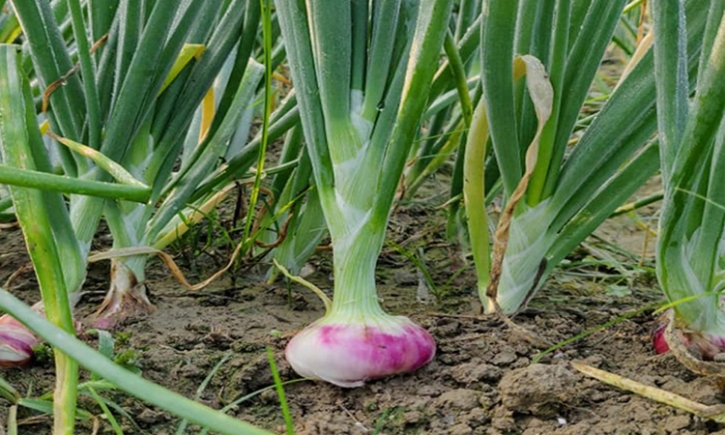
The country is moving toward self-sufficiency in onions this season thanks to a bumper harvest, with prices remaining at a tolerable level. Farmers and agricultural experts attribute the strong yield to several factors, including the construction of more than 900 government-supported storage facilities, proper supervision by the Department of Agricultural Extension (DAE), and favorable weather conditions that reduced disease outbreaks. As a result, onion imports have also declined. DAE sources said in the 2025–26 fiscal year, onions have been cultivated on 286,300 hectares of land, with a production target of 42,64,100 metric tons.
Farmers involved in onion cultivation and Department of Agricultural Marketing (DAM) officials said the production target is likely to be achieved this year. Meanwhile, onion imports in the 2025–26 fiscal year stood at 86,398.84 metric tons, compared to 473,811.27 metric tons in 2024–25. Annual domestic demand for onions is typically 35-36 lakh metric tons. According to DAE and other sources, although production capacity has increased, about 25–30 percent of onions are lost during storage and marketing stages. This leads to a shortfall relative to demand, requiring imports to fill the gap. DAM Director General Nasir-Ud-Doula told BSS that the country is on track to meet its production target, with adequate supply and stable prices currently in the market.
He noted that around 900 storage units have been constructed nationwide under two projects, and farmers at the grassroots are being informed about proper storage methods. While imports were initially planned to address potential shortages, sufficient domestic production has reduced the need for imports. The government is also ensuring that farmers receive fair prices for their produce. Partha Kumar Mondal, an onion farmer from Banamalipur village in Faridpur’s Boalmari upazila, said the harvest this year has been exceptional. He has stored onions using modern methods in hopes of earning higher profits. “We have harvested far more onions than in previous years—an unimaginable amount,” he said.
Another farmer, Sadhan Hira from the same union, said yields per decimal of land have increased significantly compared to last year, reaching about 3.5 maunds per decimal. Farmers said onions are currently selling at around 1,000 taka or more per maund, significantly higher than last year. With higher yields, production costs per unit have decreased, raising hopes of better profits. According to data from the National Board of Revenue (NBR), 42,50,000 metric tons of onions were produced in the 2024–25 fiscal year in 280,100 hectares of land. For 2025–26, cultivation has been expanded to 286,300 hectares, with a production target of 42,64,100 metric tons.
Import figures show a steady decline over recent years, dropping to 86,398.84 metric tons in 2025–26 from 473,811.27 metric tons in 2024–25. Project Director, Modernization of Onion and Garlic Storage System at farmers Level and Marketing Activities Development Project, DAM, Md Helal Uddin said the bumper harvest has led to the lowest import levels in recent years. He added that a model storage facility built under the project can store up to 300 maunds of onions and is designed to serve five farmers. The goal is to encourage farmers to build similar structures themselves, he added.
Agriculture Ministry sources said the government is implementing a project to modernize onion and garlic storage using an airflow system and improve marketing activities. Responding to a question in parliament, Agriculture Minister Mohammed Aminur Rashid said 25–30 percent of onions are lost due to improper storage. With the introduction of new airflow technology, onions can be preserved for eight to nine months, potentially enabling full self-sufficiency. Officials involved in the project of onion storage said the Housing and Building Research Institute has designed model storage units for onions and garlic.
Built on small plots using tin, bamboo, iron, and concrete, these structures include three-tier racks, ventilation systems, six fans for temperature control, and protective coverings. Each unit can preserve onions for six to nine months and construction cost is about Taka 450,000. Agriculture experts say that ensuring proper storage and market management will further increase farmers’ profitability and have a positive impact on the country’s agricultural sector.