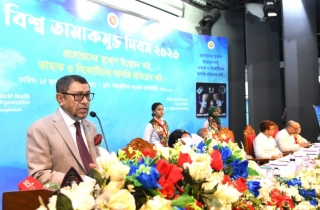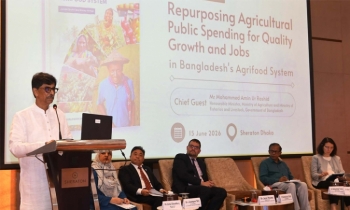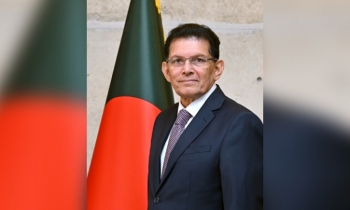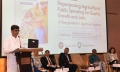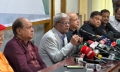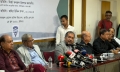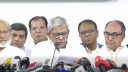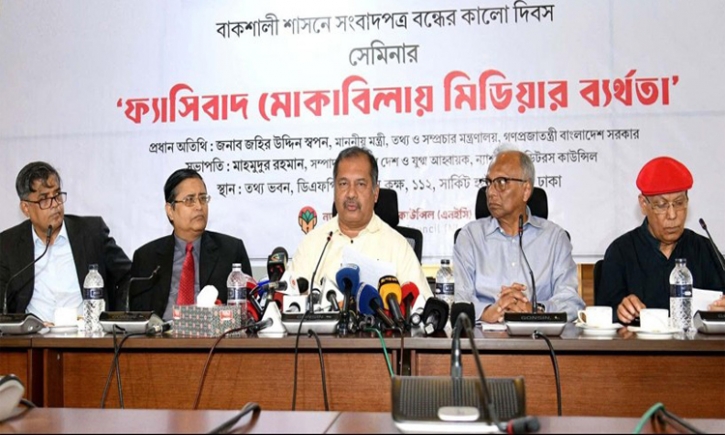
Information and Broadcasting Minister Zahir Uddin Swapon addressed a seminar titled “Remembering the Black Day of Newspaper Closure under BAKSAL Rule" and "Media Failure in Confronting Fascism" as the chief guest. Photo: pid
Information and Broadcasting Minister Zahir Uddin Swapon, MP, today said that establishing an independent and responsible media commission based on an objective perspective is essential in the present context. The commission would identify problems prevailing in every sector of the media and show ways to address them, he said, adding that alongside ensuring media freedom, it would also define the boundaries of responsibility. The Minister was addressing as the chief guest a seminar titled “Remembering the Black Day of Newspaper Closure under BAKSAL Rule" and "Media Failure in Confronting Fascism", organised by the National Editors Council (NEC) at the DFP conference room in the Information Building here.
He said whenever media freedom is discussed; the coexistence of diverse opinions naturally comes into consideration. Likewise, when media responsibility is discussed, the issue of accountability also emerges.“If we fail to stand on an objective outlook, it will not be possible in future to establish an independent and responsible media commission," he noted. Referring to past experiences, the minister said that as a newspaper reader, it appeared to him that all previous initiatives in this regard were partial. Since those efforts never reached completion and failed to create any structure, it was not possible to build Bangladesh's media into a strong institution, he said, adding that the responsibility for this should be borne by the previous government.
Zahir Uddin Swapon said a Press Commission had once been formed under the leadership of Ataur Rahman Khan, but its report and recommendations never saw the light of day. He called for the formation of a media commission under the leadership of a former distinguished judge, taking that instance into consideration. Representatives from the Information and Law Ministries, the National Editors Council, various trade unions of newspapers and the National Press Club could be included in the commission, he opined. Mentioning that the commission would formulate policies, laws and structures, the minister it would create opportunities for the development of both the professional and commercial aspects of the media while promoting ethical journalism and preventing the drift towards irresponsible journalism and malpractice.