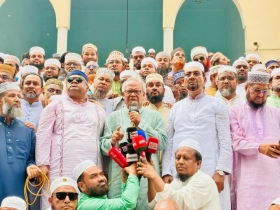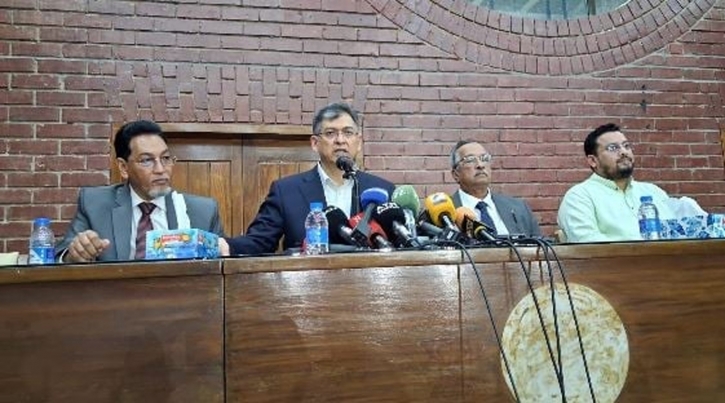
Home Minister and Chairman of the Special Committee on Constitutional Amendment of the Jatiya Sangsad, Salahuddin Ahmed, today spoke at a press briefing at the Media Centre at the Cabinet Room of the Parliament House.
Home Minister and Chairman of the Special Committee on Constitutional Amendment of the Jatiya Sangsad Salahuddin Ahmed today called for the participation of the opposition in the process of amending the Constitution.
"The proposals and opinions of the opposition would also be considered in the constitutional amendment process if they participate in the committee’s discussions," he said.
He made the remarks at a press briefing at the Media Centre of the Jatiya Sangsad today following the third meeting of the special committee at the Cabinet Room of the Parliament House.
Chairing the committee meeting, Ahmed said, “We have repeatedly invited the opposition. We are still inviting them—whenever they join this committee, we will welcome them. Their views and proposals will be discussed.”
He said participation in the discussions would make it possible to incorporate and reconcile various issues raised by the opposition.
"The government wants to complete the important national task of amending the Constitution on the basis of consensus without creating divisions," he said.
Committee members and Chief Whip of Parliament Nurul Islam Moni, Chairman of the Parliamentary Standing Committee on the Ministry of Home Affairs Zainul Abedin, State Minister for Planning Zonayed Abdur Rahim Saki, State Minister for Land Mir Mohammed Helal Uddin, State Minister for Social Welfare Ms. Farzana Sharmin and Md Mahmudul Hoque Rubel were present at the meeting.
Editors of national dailies, senior journalists and representatives of different journalist organisations also took part in the meeting and gave their opinions, proposals and suggestions on various issues relating to constitutional amendments.
Regarding the possible timeline for the constitutional amendment process, Salahuddin Ahmed said they were making strong efforts to place the committee’s report before Parliament by December.
After that, a constitutional amendment bill would be brought through the Ministry of Law, Justice and Parliamentary Affairs, he said.
According to the minister, if everything goes according to plan, the bill could be placed in the first parliamentary session of next year, he said, adding that the committee had already announced its target of completing discussions and submitting its report to Parliament by December.
He said the constitutional amendment process would begin with the introduction of a bill in Parliament.
After discussions on the bill and the disposal of proposed amendments and objections, the amendment would be passed in accordance with parliamentary rules, he continued.
The minister said a referendum would then be held before the President’s assent in cases where the Constitution requires a referendum for amendments to particular constitutional provisions.
On the issue of a constitutional referendum, Ahmed said a general referendum and a constitutional referendum were not the same thing.
A referendum may be required under the constitutional provisions when changes are made to certain specific provisions of the Constitution, he said, referring to Article 142 of the Constitution.
Ahmed also explained to journalists the constitutional procedure for such a referendum.
He said, “First, the amendment will be passed in Parliament. Then, before the President gives assent, a referendum will be held on those articles for which the Constitution provides for a referendum when changes are made. If the people vote in favour, the President will then give assent.”
He further said the referendum provision could apply when amendments were proposed to certain fundamental provisions of the Constitution.
However, he said, which articles would be amended would be determined through discussions in the committee and the subsequent parliamentary process.
Salahuddin Ahmed, also a Standing Committee Member of the ruling BNP said, “We want unity among ourselves; we do not want any division. We will implement the July National Charter exactly as it was signed. There are also some issues that were not discussed or were avoided in the discussions of the Consensus Commission. We want to adopt those as well on the basis of consensus.”
He said the committee would also consider commitments contained in the ruling BNP’s election manifesto where constitutional amendments would be required for their implementation.
At the same time, issues that could appropriately be incorporated into the Constitution based on the views of people from different professions and sections of society, as well as public sentiment, would also be reviewed.
Issues that can be implemented through legislation, however, would be addressed through legislation, he said.
About opinions of journalists, Ahmed said most of the journalists who attended today’s meeting had given their views and proposals on various issues would be reviewed.
Many of them had also said they would submit their proposals in writing, he said.
The committee would receive those written proposals and consider them through discussion, he stated.
He said the journalists had provided detailed opinions on various issues, ranging from the Preamble of the Constitution to different articles and the implementation of the July National Charter.
After consultations with stakeholders at different levels, a report and a booklet would be prepared incorporating their views, he said, adding that the main report of the Special Committee would remain separate.
The committee chairman said the July National Charter was the main basis of their work.
However, he said that commitments made to the people in the election manifesto would also be considered while formulating recommendations for constitutional amendments.
He said, “The priority is the July National Charter. However, we will also incorporate the issues on which we received a mandate from the people according to our election manifesto.”
Ahmed said the issue of faith and trust in Almighty Allah in the Preamble and the fundamental principles of state policy was also part of their election commitments.
Although no unanimous decision was reached on these issues during the discussions of the National Consensus Commission, he said, they remained part of their electoral commitments.
Therefore, he said, these issues would be considered while formulating recommendations for constitutional amendments.