Around 3,000 people in Kashiani upazila of the district are earning their livelihoods by collecting and selling water lilies from canals, wetlands and other water bodies during the monsoon, generating an annual trade worth crores of taka.
Kashiani is a wetland-dominated area where large parts of the landscape remain submerged during the rainy season. Water lilies grow naturally in the flooded canals, beels and other water bodies, providing seasonal employment for farmers, unemployed people and others when agricultural activities decline.
The aquatic flower is also widely consumed as a vegetable and helps meet local nutritional needs while creating an income source for hundreds of people during the monsoon.
Every morning, men and women of different ages set out in boats to collect water lilies from wetlands including Singa, Rahuthar, Hatiara and Shiltas. As the occupation requires little or no investment, collectors consider it a profitable seasonal livelihood.
Water lilies generally grow abundantly in flooded Boro paddy fields, jute fields and Aman paddy fields during the rainy season.
Although the water lily is Bangladesh’s national flower, it is also popular as a vegetable in many parts of the country.
A wholesale market has developed at Rahuthar in Kashiani around the water lily trade.
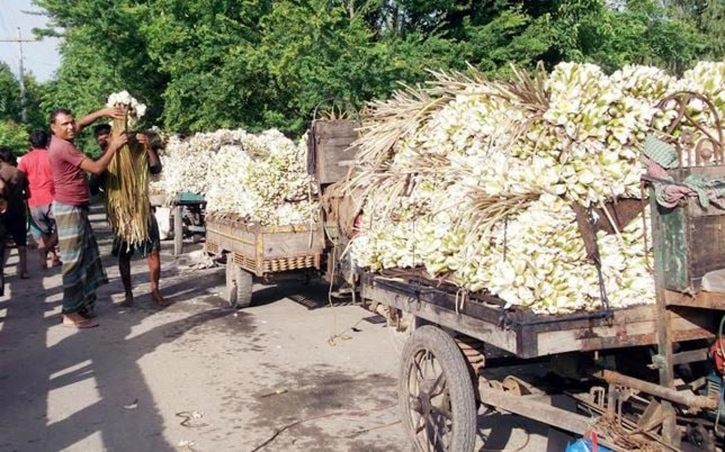
Before sunrise, collectors from nearby villages and remote areas gather at the market with their harvest. The market becomes busy with buyers and sellers, while the large quantities of white water lilies create a distinctive scene along the roadside.
Wholesalers purchase the flowers and transport them to Gopalganj town and neighbouring areas, including Jashore, Magura, Jhenaidah, Narail and Lohagara.
Shankar Kumar Basu, leaseholder of the Rahuthar water lily wholesale market, told BSS that men and women from different areas collect water lilies early in the morning and bring them by boat to sell at wholesale prices.
“Wholesalers purchase the water lilies and transport them by vans, easy-bikes and Nasimons to Kashiani headquarters as well as Jashore, Khulna, Alfadanga and Bhatiapara,” he said.
Around 20 to 30 vehicle filled with water lilies leave the market for different districts every day, he added.
Gobinda Biswas, a water lily collector, said he has been supporting his family by selling water lilies during the rainy season for the past 10 years.
“I can collect water lilies worth around Tk 500 to Tk 700 every day. I sell them to wholesalers at Rahuthar market early in the morning,” he said.
Kashiani Upazila Agriculture Officer Md Ejazul Karim told BSS that water lily collection is helping meet people’s nutritional needs while also creating employment opportunities.
“There is virtually no crop production in Kashiani’s wetland areas during the monsoon, leaving farmers without work. At that time, they collect water lilies from the wetlands and sell them in the market to meet their household expenses,” he said.