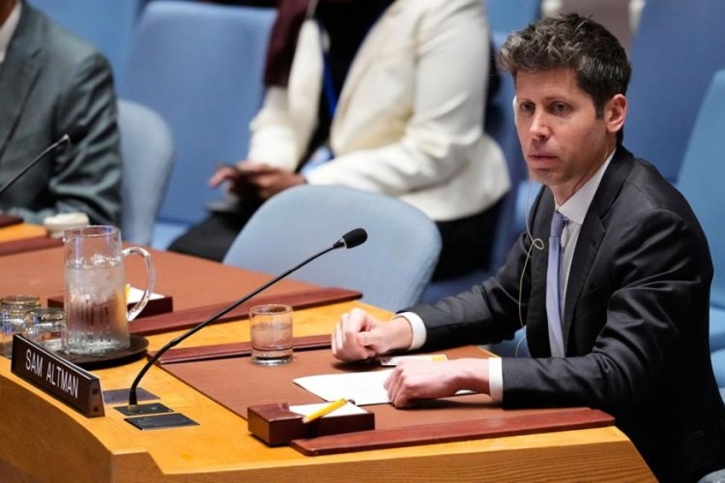
The heads of major artificial intelligence firms pleaded with the United Nations on Wednesday to set strict international controls over the burgeoning technology they are designing, warning that immediate action is necessary to save humanity from catastrophic risks. In a rare historical moment where industry pioneers actively campaigned for heavy regulation of their own products, executives underscored the existential stakes of the generative AI revolution before a tense U.N. Security Council. “If managed poorly, I even believe AI could be a risk to humanity as a whole,” testified Dario Amodei, the chief executive officer of Anthropic. Amodei emphasized that the rapid, exponential scaling of machine learning systems presents unpredictable, emergent behaviors that even the foremost researchers do not yet fully comprehend. “We could lose control of the future to AI,” echoed his competitor, Sam Altman, CEO of OpenAI. Altman, who has spent recent months touring global capitals to push for an international regulatory framework, proposed an agency similar to the International Atomic Energy Agency (IAEA) to oversee AI systems surpassing certain capability thresholds. Both executives stressed that the nations of the world, acting cooperatively through the U.N.
Security Council, must establish binding, enforceable safeguards. These would serve as actual controls—such as computing power limits, licensing requirements, and mandatory safety audits—to prevent artificial general intelligence from becoming too powerful to rein in. They also called for the international community to ensure that the monumental power of AI is not concentrated exclusively within one corporation or a single geopolitical superpower, aiming to democratize both the economic benefits and the critical oversight. For world leaders, the most immediate and terrifying question regarding artificial intelligence is profoundly basic: Who should ultimately control life-and-death decisions—a human or a machine? The Security Council huddled with these top technology leaders to decipher whether the increasing abilities, autonomy, and pervasiveness of artificial intelligence can realistically be controlled by a centralized global authority. The logistical and geopolitical challenges are immense. Member states wrestled with lingering questions: How could such an international framework be enforced across rival nations without stifling innovation? What international auditing mechanisms could penetrate proprietary corporate architectures?
And crucially, when might it be simply too late to put the algorithmic genie back in the bottle? The diplomatic urgency of Wednesday’s session was amplified by U.N. Secretary-General António Guterres, who just the day before issued a stark warning regarding the proliferation of “killer robots.” While the phrase might evoke mid-century science fiction, military experts and European leaders affirmed during the testimonies that the warning is not hyperbole. Lethal Autonomous Weapons Systems (LAWS)—drones and defense networks capable of independently identifying, selecting, and engaging targets without meaningful human oversight—are already a battlefield reality or perilously close to widespread deployment. The debate ultimately shifted the focus from theoretical algorithmic doom to the urgent need for actionable, binding treaties, leaving the global community facing a rapidly closing window to govern the fundamental architecture of the future.