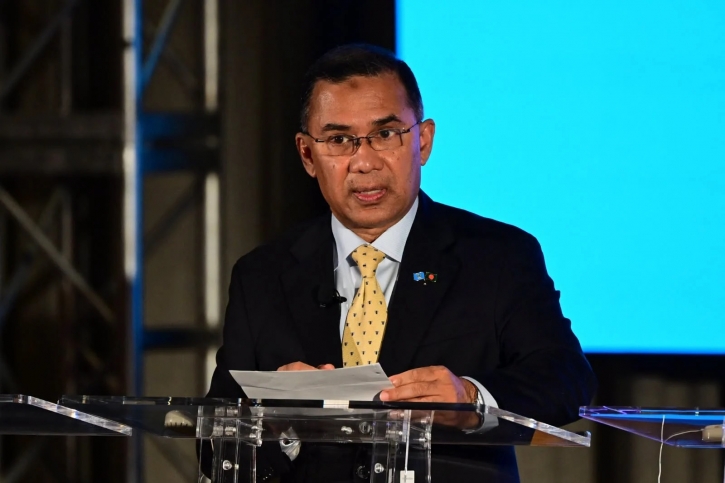
Prime Minister Tariq Rahman has called upon world leaders to build a safer and more sustainable world
for future generations. He said, Let us work together and build a safer and more sustainable future for
the coming generations.
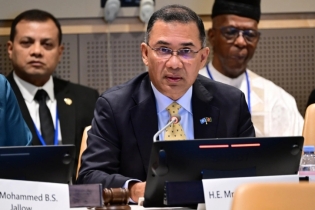
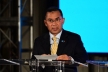
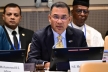
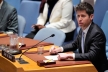
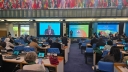
On Wednesday (September 23), the Prime Minister made these remarks during a high-level meeting
titled XZ
*Climate Action and the Just Transition' at the Trusteeship Council of the United Nations
Headquarters in New York. The meeting was held at the initiative of UN Secretary-General António
Guterres. During the meeting, he placed special emphasis on ensuring accessible financing for climate-vulnerable
countries to tackle climate change risks, limiting global warming to 1.5 degrees Celsius, increasing access
to climate-smart technologies, expanding the use of renewable energy, and fully implementing the Loss
and Damage fund.
The Prime Minister pointed out that although Bangladeshs contribution to global greenhouse gas
emissions is less than 0.5 percent, it is one of the world s most vulnerable countries to climate change.
He warned that by the end of this century, 12 to 18 percent of Bangladesh s coastal areas could be
submerged due to sea-level rise. This would severely jeopardize the livelihoods of tens of millions of
people, as well as put the country's food security at grave risk.
Noting that the losses and damages caused by climate change are equivalent to about 1 percent of
Bangladesh's GDP, the Prime Minister stated that approximately $3.19 billion has been allocated for
climate adaptation in the current fiscal year's budget. However, he cautioned that it is impossible for
Bangladesh to single-handedly avert the risk of such massive losses without international assistance.
Highlighting various government initiatives to protect the environment, he announced that Bangladesh
plans to plant 250 million trees over the next five years. Concurrently, excavation work on about 20,000
kilometers of rivers and canals is underway to conserve water, reduce flood risks, revitalize wetlands,
and maintain normal groundwater levels. In addition, implementation of the master plans for the Padma
and Teesta barrages is moving forward.
The Prime Minister further stated that a target has been set to meet 20 percent of the country s
electricity demand from renewable energy by 2030. Alongside this, the government is working on
expanding green industries, including jute products, eco-friendly transportation, waste-to-energy
production, and circular economy initiatives. An initiative to develop a national carbon market is also
underway. He stated that it is not possible for Bangladesh to achieve these goals alone. Based on the principle of
common but differentiated responsibilities and respective capabilities, collective action is now
essential.
To tackle the climate crisis, the Prime Minister called for five urgent actions:
First, reducing global greenhouse gas emissions to maintain the 1.5 degrees Celsius global warming limit
set in the Paris Agreement. Second, ensuring predictable and accessible financing in the adaptation sector for climate-vulnerable
countries. Third, creating a fair and equitable path to climate transition by ensuring greater access to climate-smart
technologies.
Fourth, expanding the use of renewable energy through accessible financing, capacity building, and
technology transfer. Fifth, ensuring the full implementation of the Loss and Damage fund alongside its regular replenishment.
The Prime Minister expressed hope that Bangladesh will receive the necessary support from
international partners to implement its climate plans.
It is to be noted that Prime Minister Tariq Rahman is currently in New York to attend the 81st session of
the United Nations General Assembly. He is scheduled to deliver a speech on behalf of Bangladesh
during the general debate on September 24.