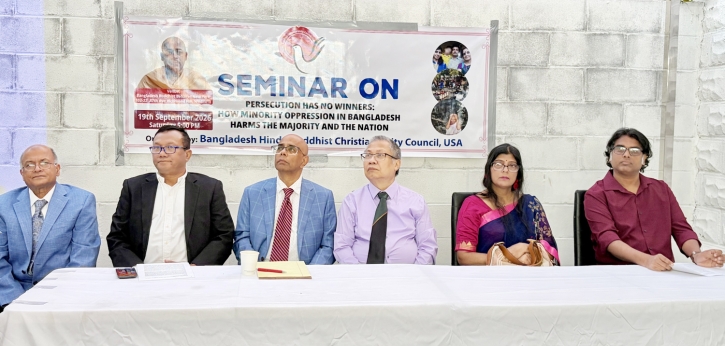
Concerns over the safety of religious and ethnic minorities in Bangladesh and the broader implications of communal violence for the country's democratic institutions and national security dominated a major international seminar held in Jamaica, New York, last Saturday.
Titled “Persecution Has No Winners: How Minority Oppression in Bangladesh Harms the Majority and the Nation,” the seminar was organized by the Bangladesh Hindu Buddhist Christian Unity Council, USA. Speakers, researchers, lawyers and community representatives discussed what they described as a prolonged pattern of discrimination and violence against minority communities and warned that failure to address the incidents could have consequences extending far beyond individual communities.
The speakers argued that attacks against minorities should not be viewed solely through a communal or religious lens. According to the keynote paper presented at the seminar, repeated violence, inadequate protection and the failure to ensure accountability can weaken public confidence in state institutions, the rule of law and citizenship.
The keynote paper was jointly authored and presented by minority researcher Mrinmoy Samaddar and attorney Ashok Kumar Karmakar. Their presentation examined what they described as a historical continuum of discrimination and insecurity affecting minority communities in Bangladesh.
The paper traced developments from constitutional commitments made after the country's independence to the Enemy Property and Vested Property laws, constitutional amendments, attacks following the demolition of the Babri Masjid in India, violence following the 2001 national election, incidents in 2013, the Nasirnagar attacks of 2016, and the communal violence centered in Cumilla in 2021. The presentation also discussed developments surrounding Bangladesh's political transition in 2024 and subsequent incidents.
According to the researchers, the central concern is not only the occurrence of individual attacks but also the broader question of accountability. They argued that when perpetrators of violence are not effectively prosecuted, a perception of impunity can develop, potentially increasing the risk of further attacks.
The presentation further argued that insecurity affecting one minority community can eventually have wider consequences for society. The speakers referred to religious and ethnic minorities—including Hindus, Buddhists, Christians, Indigenous communities, Ahmadiyya Muslims, Sufis, Bauls and Fakirs—while also pointing to threats faced by journalists, teachers, cultural activists, political opponents and ordinary citizens.
The keynote paper therefore framed minority protection as part of a broader discussion about democratic governance, institutional accountability, social stability and national security.
Swapan Kanti Das, general secretary of the organization, delivered the welcome address. He alleged that religious minorities in Bangladesh continue to face insecurity and criticized what he described as inadequate and insufficiently visible measures by government authorities to protect vulnerable communities.
Several prominent speakers participated in the seminar, including writer Taslima Nasrin, Professor Rajesh Sampath, human rights lawyer Advocate Manzil Murshid, and attorney Ashok Kumar Karmakar.
Speaking as a guest of speaker, Taslima Nasrin expressed grave concern about the situation of Hindus in Bangladesh. She argued that persistent insecurity has contributed to migration from the country and said that many members of the Hindu community have been forced to leave their ancestral homes.
Other speakers focused on the issue of accountability and the challenges of documenting and reporting communal violence. Discussions also examined how international media organizations, including the BBC and Al Jazeera, have covered specific incidents involving minority communities in Bangladesh.
Urbashi Sanyal delivered a presentation examining what she described as different dimensions of ethnic cleansing and violence affecting minority populations. Her presentation placed particular emphasis on the relationship between repeated attacks, displacement and demographic change.
Demographic trends were another major subject of discussion. Data and historical population statistics presented at the seminar were cited by participants as evidence of a substantial decline in the relative share of minority communities in Bangladesh over several decades. Speakers associated the demographic change with migration and displacement, although the causes of demographic change are complex and may include multiple social, economic and political factors.
The speakers also emphasized that minority insecurity can have implications for the wider population. Their argument was that a society in which certain groups are unable to exercise equal citizenship rights may face broader challenges involving social cohesion, institutional trust and the rule of law.
The seminar was jointly presided over by Nayan Barua and Gita Chakraborty, presidents of the Bangladesh Hindu Buddhist Christian Unity Council, USA.
In their presidential address, the two leaders called for an immediate end to attacks against minority communities and urged the Bangladeshi state to ensure equal rights and security for all citizens, regardless of religion or ethnicity.
The issue of minority protection has also received international attention in recent years. United Nations human-rights discussions have included concerns about attacks affecting religious minorities and Indigenous communities in Bangladesh, underscoring the continuing international scrutiny of human-rights conditions in the country.
Participants at the New York seminar said that addressing minority insecurity requires more than statements of condemnation. They called for effective investigation of allegations, accountability for perpetrators, protection of vulnerable communities and equal application of the law.
The seminar concluded with an open discussion in which participants voiced concern about the country's current social and political environment. Speakers and attendees called for stronger national and international attention to minority rights and urged measures aimed at strengthening democratic institutions, equal citizenship and public security.
The central message emerging from the discussion was that the protection of minority communities is closely connected to the broader question of how effectively a state protects the rights of all its citizens. For the organizers and speakers, ensuring equal security and legal protection for religious and ethnic minorities is therefore not simply a matter of community interest, but an issue with wider implications for Bangladesh's social stability, democratic institutions and national cohesion.