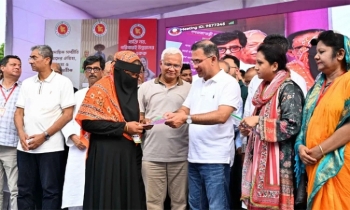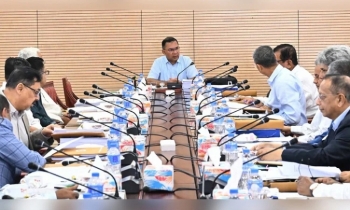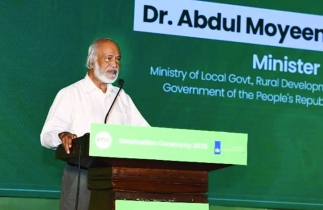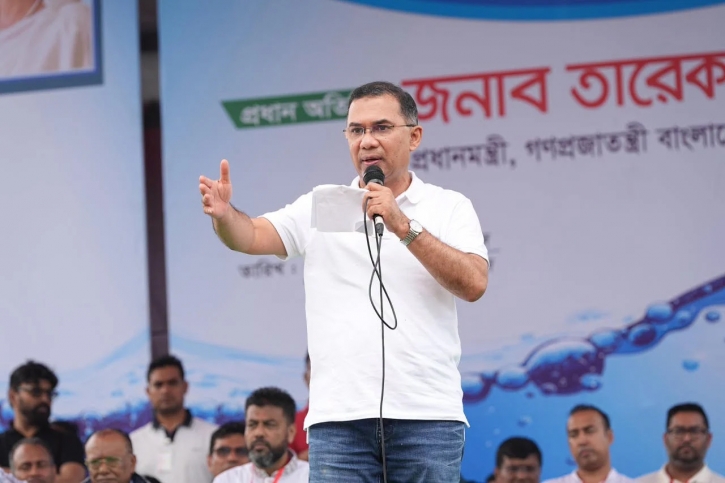
Prime Minister Tarique Rahman addressed a public rally in the Parshuram upazila of Feni. Photo: PMO
Prime Minister Tarique Rahman today said the government, with all its strength, would ensure equal application of the law for everyone and gradually establish the rule of law in the country, which was destroyed by the previous fascist regime.
“When the people of this country have entrusted BNP with responsibility of running the government, it will, with all its strength, InshaAllah, ensure that the law is equal for everyone,” he said.
The Prime Minister made the remarks while addressing a public rally after inaugurating the Muhuri-Kohua Flood Control, Drainage and Irrigation Project Rehabilitation (Phase I) at the Kheyaghat Ghat-Muhuri Bridge area in Parshuram upazila of Feni.
The Prime Minister said, “We have seen how the rule of law was destroyed over the past 17 years. We want to change that situation and gradually establish the rule of law.”
Referring to the recent incidents involving some political parties, Tarique Rahman said some groups were trying to create unrest in the country by capitalising on certain “undesirable incidents”.
He said such attempts could disrupt the government’s development and welfare programmes, ultimately causing losses to the people.
He mentioned the Family Card, Farmer Card, canal and river excavation, expansion of upazila health complexes and reopening of closed mills and factories as some of the programmes being undertaken for the people.
“If these works are obstructed, who will suffer the loss? The people of this country will,” he said.
Referring to the allegations of violence against women involving members of a political group, the Prime Minister urged them to first look into allegations of misconduct within their own ranks before criticising others.
Turning to his government’s development programmes, the Prime Minister announced that all upazila health complexes across the country would be upgraded from 50 beds to 150 beds within the next five years.
He said the move was aimed at ensuring that people could receive necessary treatment closer to their homes without having to travel to district towns or Dhaka unless they required specialised care.
“Within the next five years, InshaAllah, we will transform every upazila hospital from 50 beds to 150 beds,” he said.
The Prime Minister said the expanded facilities would include dialysis services and treatment facilities for mothers and children, while new departments would be opened with the addition of 100 beds.
Referring to the 50-bed hospital in Parshuram, Tarique said its first 30 beds were established during the tenure of Shaheed President Ziaur Rahman and the facility was later expanded to 50 beds during the government of Begum Khaleda Zia.
He said a demand had been placed before him to upgrade the hospital to 100 beds, but he decided to raise its capacity to 150 beds.
The Prime Minister said the healthcare initiative was part of BNP’s programmes aimed at improving the lives of ordinary people.
Tarique Rahman said the government was also moving ahead with the Family Card programme to make women in working families financially self-reliant.
The Prime Minister said the government would also provide Farmer Card to small, marginal and middle-income farmers so that government assistance could reach them directly.
He said the initiative was intended to eliminate intermediaries in the delivery of government support to farmers.
He recalled that the government had already fulfilled its election pledge to waive agricultural loans of up to Tk10,000, including interest.
According to him, the loans were waived within the first seven days of the government taking office at a cost of Tk1,500 crore, benefiting around 1.3 million farmers across the country.
Regarding the Muhuri-Kohua project, Tarique Rahman said the government had started re-excavating the canal connecting the Muhuri and Kohua rivers as part of its broader canal and river excavation programme.
He recalled the devastating floods of 2024, when water flowed over the bridge and homes in Feni as well as Noakhali and Lakshmipur were inundated.
He said the government had announced the canal and river excavation programme before the election because such work was important for flood control, agricultural irrigation and ensuring water facilities for rural communities.
He said the programme would directly benefit around 450,000 people in the area.
The Prime Minister said around 34,000 hectares of farmland would receive irrigation facilities as a result of the project, leading to an estimated increase of around 100,000 tonnes in crop production.
“If crop production increases, farmers will benefit. If crop production increases, we will be able to keep food grain prices within the purchasing capacity of ordinary people,” he said.
The Prime Minister described the canal and river excavation programme as a continuation of an initiative launched during the tenure of former President Ziaur Rahman.
The Prime Minister also said the government was working to reopen mills and factories that had been closed over the past 17 years.
He said the government had been holding discussions with both domestic and foreign investors and offering necessary facilities to encourage them to restart the industries.
“If these mills and factories reopen, the sons and daughters of our country will get employment opportunities,” he said.
He said increased employment would gradually bring economic stability to families, make people more self-reliant and contribute to the country’s economic development.
Tarique Rahman said his government’s programmes included measures for unemployed people, women, farmers, healthcare, students and local development.
He said the people had given BNP the responsibility of governing the country in the February 12 election and that the government was implementing its programmes based on that mandate.
The Prime Minister called on the people to remain alert in protecting the country’s democratic process.
He said the programmes initially announced by BNP had now become programmes for the people and pledged to continue implementing them. “These are no longer merely BNP programmes; they are now the programmes of the people,” he added.
He also pledged to continue the country’s democratic process “at any cost” and sought people’s prayers so that he could fully implement the programmes undertaken for them.
Earlier, after inaugurating the Muhuri-Kohua Flood Control, Drainage and Irrigation Project Rehabilitation (Phase I), the Prime Minister planted a sapling near the Kheyaghat Ghat-Muhuri Bridge area.
Later, he inaugurated the excavation of a canal by cutting soil as part of the project. He also inaugurated river dredging and embankment construction by operating a dredger to remove sand from the riverbed.
Environment, Forest and Climate Change Minister and Feni-3 lawmaker Abdul Awal Mintoo, Water Resources Minister Shahiduddin Chowdhury Anee, State Minister for Water Resources Forhad Hossain Azad, Feni-1 lawmaker Rafiqul Alam Maznu, Feni-2 lawmaker Joynal Abedin and lawmaker Rehana Akter Ranu, among others, were present.