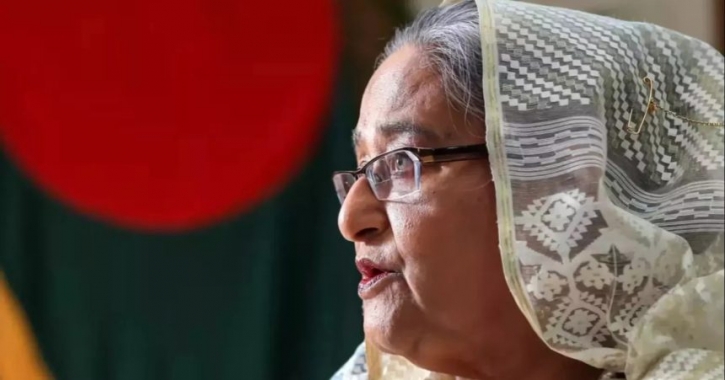
Ousted Prime Minister Sheikh Hasina has said she will surrender after returning to Bangladesh from India in December. She revealed the plan in a telephone interview with Reuters on Friday. In the interview, the Awami League president said that senior leaders of her party also want to return to Bangladesh and surrender before the court.
On May 23, a Times of Bangladesh report titled ‘Hasina wants to face trial’ reported that Sheikh Hasina has expressed her strong desire to stand by the party’s grassroots leaders and activists after returning to Bangladesh in December this year. At that time, Awami League Joint General Secretary AFM Bahauddin Nasim said that the Awami League was preparing to organize a ‘big rally’ centered around Sheikh Hasina’s return to Bangladesh. He said that the leader’s return would be ‘heroic’. Party internal sources had said at the time that Sheikh Hasina might try to get a travel permit from the Bangladesh High Commission in New Delhi as her diplomatic passport was cancelled. In an interview with Reuters, Sheikh Hasina admitted to the great risks of returning to the country. "If I return, they may arrest me, even kill me. Still, I have to go," she said. Despite all the risks, she expressed her desire to return to the country where her parents' graves are.
Regarding her departure in the context of the July 2024 coup, the ousted prime minister said that she was forced to leave the country at that time because her life was threatened when the crowd approached her residence during the student-led movement. She described the ongoing trial and death sentence against her on charges of ordering the repression of protesters as a "farce." "If I surrender and return to the country, the matter will be clear to the people. I am not worried about imprisonment," she said. Sheikh Hasina also mentioned her experiences of arrests in 1981 and 2007. He said that he has not consulted any foreign government about when or how he will return to the country, despite legal pressure. The BNP government is watching the possibility of the Awami League president returning to the country with great caution. The government's policymakers believe that this is a dangerous 'political trap', the only purpose of which is to create chaos in the country. Prime Minister Tarique Rahman recently warned that Sheikh Hasina's plan to return to the country is a 'planned strategy' through which an attempt may be made to reactivate Awami League leaders and activists and incite protests on the streets. BNP policymakers fear that if the Supreme Court upholds her death sentence despite a possible appeal, then major political unrest and 'anarchy' may arise in the country.
The possible return of this leader, who has been in power for the longest time in Bangladesh's history, could be a major test for the stability of the current government. At the same time, it may also have an impact on the tense relations between Dhaka and New Delhi. Bangladesh has repeatedly requested India to send Sheikh Hasina back. However, the Indian Ministry of External Affairs said that they are reviewing the matter and are committed to further strengthening the relations between the two countries. Sheikh Hasina said that she is currently running the party through online meetings. She has held these meetings with leaders and activists of 125 out of the 300 parliamentary constituencies in the country. She said, "If the death penalty verdict remains, I may not be able to participate in the elections." However, questioning the decision to suspend the activities of the Awami League, she said, "If we have done something wrong, then the people will decide." Sheikh Hasina also commented that "mistakes can be made" during a long period of rule.
However, she believes that only the people have the right to make the final judgment on a government. Sheikh Hasina was one of the most influential figures in Bangladeshi politics for almost half a century. She rose to the center of politics after Sheikh Mujibur Rahman, one of the leaders of the liberation war, and most of his family members were killed in a military coup. Although she is credited with turning the country's economy around during her long 20-year rule, there are also allegations against her government of suppressing dissent. A United Nations report says that as many as 1,400 people may have been killed in violence during the student movement that led to the fall of Sheikh Hasina's government in 2024.