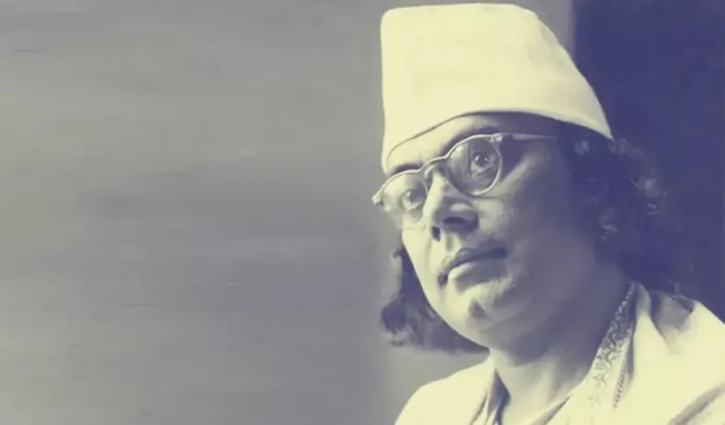
National Poet Kazi Nazrul Islam -File photo
Writer and researcher Mofiz Imam Milon has said that former Army Chief and Shaheed President Ziaur Rahman took significant initiatives after the country's independence to establish state recognition for National Poet Kazi Nazrul Islam and preserve his legacy. Talking to BSS, Milon said that on May 24, 1976, Major General Ziaur Rahman presented the National Poet with the Army Crest, a prestigious honour of the Bangladesh Army. He said that in the same year, Ziaur Rahman's government granted Nazrul Bangladesh citizenship, conferred upon him the Ekushey Padak and arranged permanent state financial assistance for his medical treatment. Milon added that after the National Poet's death on August 29, 1976, his son, Kazi Sabyasachi, and a minister of the then West Bengal government came to Bangladesh to take the poet's body to Kolkata. However, at the initiative of the then Army Chief Major General Ziaur Rahman, the poet was buried in Bangladesh with full state honours. Following his funeral prayers on August 30 at the Central Mosque premises of Dhaka University, Nazrul was laid to eternal rest with state honours.
Milon said this ensured that the National Poet's final resting place remained in Bangladesh, allowing the country's people to preserve him as an integral part of their national heritage. According to Milon, Kazi Nazrul Islam, who grew up in a modest family, believed in secular values and humanism. He said the poet's literature, music and rebellious spirit are deeply intertwined with the lives, culture and liberation struggle of the people of Bangladesh. Milon said that if Nazrul's body had been taken to Kolkata at that time, the people of Bangladesh would have been deprived of the historic opportunity to keep their National Poet in their own homeland.
He said an eyewitness of these incidents was Engineer Shamim, the son of a storekeeper at Dhaka Medical College at the time. Milon said he first learned about the matter through one of Shamim's published interviews and later contacted him to collect detailed information about the incident. He said that although Kazi Nazrul Islam's creative career was comparatively brief, his literary contributions were remarkably diverse.Milon said the poet was unique in both his personal and professional life, having composed nearly 4,000 songs, three novels, 19 short stories and five volumes of essays. He further said that after returning to Bangladesh in an ailing condition, several places associated with Nazrul in Faridpur—including Ambika Memorial Hall (Town Hall), Rajendra College, Rajendra College Ground, Ishan Institution, sites linked to educationist Humayun Kabir, and the Bakultala and Pukur ghat at Moez Manzil in Kamalapur, the residence of poet Jasim Uddin—continue to preserve memories of the National Poet.
After being brought to independent Bangladesh in 1972, Kazi Nazrul Islam was accorded the status of National Poet. In 1975, Dhaka University awarded him an honorary Doctor of Literature (D.Litt.) degree in recognition of his outstanding contribution to Bangla language and literature.