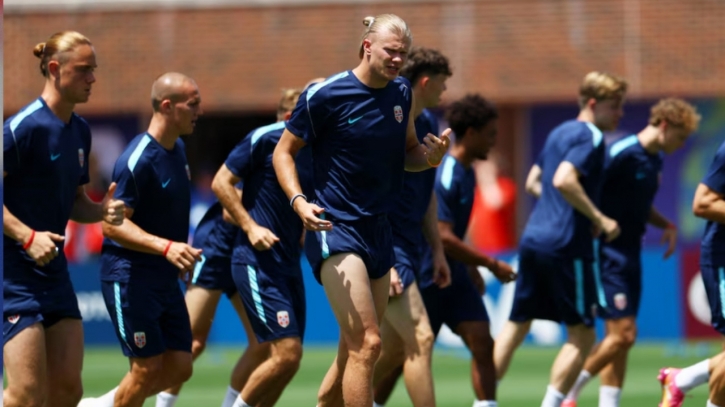
Norway striker Erling Haaland during a training session. Photo: Collected
Norway’s preparations for their round of 16 clash with Brazil at MetLife Stadium in New Jersey on Monday have been dominated by one question: can Erling Haaland recover in time to be the player they need him to be? The striker scored Norway’s 86th-minute winner against Ivory Coast on 30 June but admitted afterwards he was “dead tired” and could not have faced extra time. Coach Stale Solbakken added to the concern, revealing that Haaland had been “on his last legs” early in the second half, a significant admission ahead of a match against five-time world champions Brazil.
Both Haaland and captain Martin Odegaard had been rested for Norway’s final group match against France, which ended in a 4-1 defeat, partly to preserve them for the knockout rounds. Yet the accumulated fatigue of long, intense domestic seasons means the rest may not have been enough to fully restore either player.
Sports physiologist Dom Rae, who works with Al Nasr in the UAE Pro League, explained the challenge facing Norway’s medical staff. “Can you undo the chronic stress that has accumulated over the course of the tournament, or the last season or two? No,” he said. “These guys, especially the key players, have played a lot of matches. They are chronically fatigued. You’re not going to undo that in five days. But you can certainly freshen up to a significant level by kick-off.”
Norway have five days between the Ivory Coast victory and the Brazil match, while Brazil have six. Rae suggested the shorter turnaround may actually work in Norway’s favour. “What we generally see in sports performance is that the peak fatigue marker is around 48 hours. For some, it can trickle into 72 hours. But by 96 hours, into day five, everyone is pretty much back to normal,” he said.
“I’d actually rather have Norway’s turnaround here than Brazil’s. When you only have three or four days, it’s simple: rest, recover, prepare, play. But when you have five or six days, it gets tricky. You can’t train too hard because you’re too close to the game, but it’s too long to do nothing.”
After their group match against Iraq, Norway allowed their squad to sightsee and travel around New York during their days off, a decision Rae defended. “Walking around New York is tiring, but the brain controls stress, hormones, and sleep. If you are psychologically happy, that emotional lift is just as important as pure physical rest. It was a calculated, necessary trade-off by the coach,” he said.
Rae also offered a robust defence of the hydration breaks that have been a feature of the tournament, dismissing criticism of them as short-sighted. “Players are losing fluids, electrolytes, and sugars, and glycogen utilisation is going up because temperatures are higher and the games are getting harder. The teams that look at hydration breaks and say they need to use them as a performance answer put themselves in a better position,” he said.
Norway have never lost to Brazil in their history, including a famous 2-1 victory at the 1998 World Cup, and arrive in New Jersey as underdogs with nothing to fear.