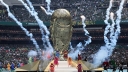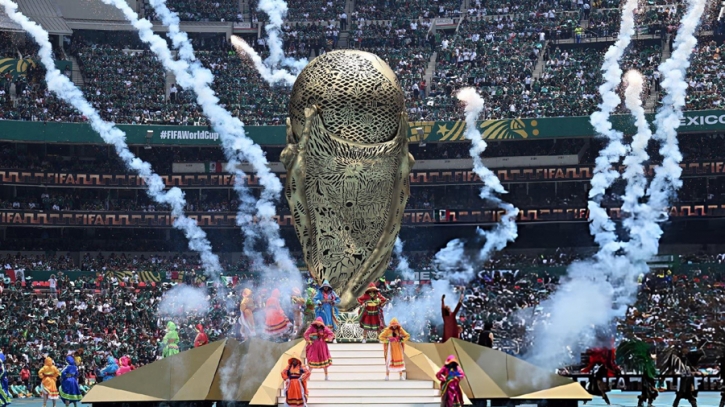
Performers entertain the crowd during the opening ceremony before the World Cup opener between Mexico and South Africa in Mexico City.
The wait is finally over. After weeks dominated by off-field controversies, visa disputes, high ticket prices and political tensions, the 2026 FIFA World Cup got under way on the early hours of 12 June as co-hosts Mexico welcomed South Africa to the iconic Estadio Azteca in Mexico City, with the football finally taking centre stage.
Schools across the Mexican capital were closed and government workers directed to work from home to ease the strain on a city teeming with supporters, media and officials. Authorities declared 11 June a public holiday in Mexico City, with access to the stadium area restricted to ticket holders and accredited personnel. Despite reports of teacher protests in the city threatening to disrupt fan events, the mood around the Azteca was one of unmistakable excitement. The opening ceremony set a vibrant tone. Celebrated Mexican acts Alejandro Fernandez, Belinda, Danny Ocean, J Balvin, Lila Downs, Los Angeles Azules and Mana performed in quick succession, with the local crowd singing along in full voice. A giant replica World Cup trophy dominated the centre of the pitch, flanked by traditional and contemporary dancers celebrating Mexican heritage. The ceremony drew comparisons to the Super Bowl halftime format, weaving multiple artists under a single celebratory vision. The headline moment came when Shakira appeared seemingly from nowhere to perform the official tournament song ‘Dai Dai’ alongside Nigerian Afrobeats star Burna Boy, sending the packed stadium into raptures. Shakira is also set to co-headline the World Cup final halftime show on 19 July alongside Madonna and K-pop act BTS.
With two further opening ceremonies still to come when the United States and Canada play their respective openers on Friday, the tournament’s carnival atmosphere is only set to grow. The United States face Paraguay while Canada take on Bosnia-Herzegovina, as the most expansive World Cup in history, featuring 48 teams and 104 matches, begins to unfold across three nations. The tournament is projected to generate a record $13 billion for FIFA. Mexico enter the competition as heavy favourites in Group A, with Opta’s pre-match simulations giving Javier Aguirre’s side victory in 66.3 per cent of projected outcomes. This is Mexico’s 18th World Cup appearance, a record for any CONCACAF nation, and the Azteca’s 20th World Cup match, more than any other venue in history. El Tri are unbeaten in their last seven tournament openers and have won five and drawn two of their seven World Cup games at this ground. Aguirre, in his third spell as Mexico manager, previously took charge of the side at the 2002 and 2010 World Cups. He also has personal history with this stage, having started all five of Mexico’s matches at the 1986 World Cup and assisted Manuel Negrete’s famous volley against Bulgaria before being sent off in the quarter-final.
South Africa arrive at their fourth World Cup and first away from home since 2002. They have never reached the knockout stage of a World Cup, and none of their nine matches in the competition have ended goalless, hinting at an open contest. The occasion carries a remarkable sense of symmetry. Exactly 16 years before this fixture to the day, it was South Africa who hosted Mexico in the 2010 World Cup opener in Johannesburg. That was the day Siphiwe Tshabalala wrote himself into football history, cutting inside from the left and driving a stunning strike into the far corner past Guillermo Ochoa. ITV commentator Peter Drury, never short of a phrase equal to the moment, declared: “It’s Tshabalala! Goal! Bafana Bafana! Goal for South Africa! Goal for all Africa! Jabulani, rejoice!” Rafael Marquez, now Aguirre’s assistant on the Mexico bench, equalised that day to make it 1-1. It remains the last time a World Cup opening match ended in a draw, and this will be the first occasion in history that an opening fixture has been repeated from a previous edition.
The Azteca holds its own memories from that era. The last two World Cup openers staged here, Mexico versus the Soviet Union in 1970 and Bulgaria versus Italy in 1986, both ended level. Whether history repeats itself again remains to be seen, but with the world’s eyes firmly fixed on Mexico City, the greatest show in football has well and truly begun.