A silent revolution of extensive Dhaincha (Sesbania) cultivation has commenced at the country's largest Foundation Seed Potato Production Farm, operated by the Bangladesh Agricultural Development Corporation (BADC) in Domar, Nilphamari—the agricultural heartland of the northern region. This innovative initiative has opened new doors of immense potential in the overall agricultural sector by restoring soil health, boosting fertility, reducing the wastage of chemical fertilizers, and significantly multiplying crop productivity.
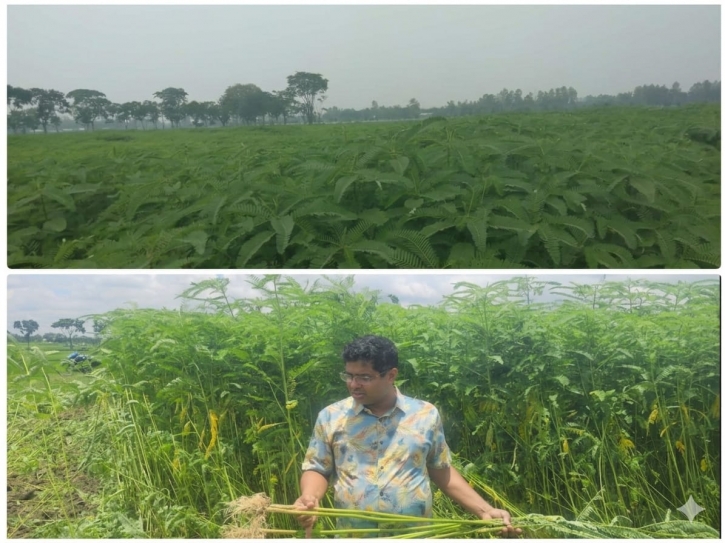
At a time when the nutritional quality of most arable land in the country is under severe threat due to the adverse impacts of climate change and years of excessive chemical fertilizer and pesticide use, the Domar BADC farm authorities have set a unique example of restoring soil vitality in an eco-friendly and cost-effective manner. In line with this, high-yielding Dhaincha has been bumper-cultivated on over 200 acres of vast land during the current production season, playing a groundbreaking and magical role in soil health protection as a green manure.
Speaking to responsible agricultural officers and field-level experts at the farm, it was learned that when these Dhaincha plants grow rapidly and reach a height of about 4 to 5 feet, they are completely crushed and incorporated into the soil through deep plowing using modern, powerful tractors. Within the next few weeks, these plants decompose naturally underground and transform into 100% pure organic matter, serving as a unique catalyst for reclaiming the lost fertility of the soil.
According to the country's leading agricultural scientists, Dhaincha is a unique gift of nature and an excellent quality green manure. Its application quickly replenishes the deficit of organic matter in the soil, enhances water-holding capacity by increasing pore spaces between soil particles, and significantly strengthens the overall physical structure and texture of the soil, which greatly facilitates root expansion for any crop.
Farm history and records reveal that although foundation seed potatoes have been successfully produced at the state level on this traditional 601-acre state-owned farm for many years, a vast portion of the land used to remain completely fallow and uncultivated for several months each year after the annual potato harvest. As a result, the productivity of the topsoil gradually deteriorated due to scorching sun and weather conditions, while essential soil nutrients and microbial activities decreased alarmingly.
To overcome this disastrous situation and ensure maximum utility of the land, a far-sighted initiative of experimental Dhaincha cultivation on fallow land was undertaken a few years ago, which has now turned into a massive success. Particularly, due to the predominance of sandy soil in a large portion of this farm, the desired yield of crops was not being achieved, and in farmers' terms, the soil had lost its vitality. Later, in 2022, under a specific plan by the BADC authorities, a massive mixture of clayey soil was introduced to alter the quality of the sandy soil. Simultaneously, regular cultivation and incorporation of high-quality organic manure and Dhaincha at intervals dramatically improved the qualitative and chemical properties of the land. As a result, the farm is now achieving eye-catching and record-breaking yields not only in potato cultivation but also in the production of high-yielding foundation seeds of Boro, Aush, and Aman rice compared to previous years.
The mastermind behind this radical transformation, the current Deputy Director and eminent agriculturist Abu Taleb Miah, has gradually brought the farm's long-neglected and uncultivated fallow lands under modern cultivation through meticulous and scientific planning since taking office. Consequently, land no longer sits idle at any time of the year; instead, the maximum utilization of this state asset is being 100% ensured through diverse seasonal crop production year-round.
The highly successful and visionary Deputy Director of the Domar Foundation Seed Potato Production Farm, Agriculturist Abu Taleb Miah, proudly told this correspondent that high-quality foundation seed potatoes and breeder seed potatoes were produced under intense care on nearly 500 acres of vast land during the current bumper production season. After harvesting the potatoes, instead of keeping the land idle or fallow, Dhaincha is being cultivated this year as well, acting as the ultimate friend of the soil and a natural green manure. It unbelievably accelerates the soil's natural fertility, nutrient retention, and water absorption capacities while enhancing its physical structure from within, making the land completely fertile and ideal for planting the next major crop.
Highlighting a crucial scientific statistic, he added that after naturally decomposing into the soil, the Dhaincha plant detoxifies the land from chemicals and directly supplies about 90 to 120 kg of natural nitrogen per hectare. This is equivalent to the efficacy of approximately 200 to 220 kg of artificial and harmful urea fertilizer available in the market. As a direct positive impact, the requirement and use of chemical urea fertilizer during the next crop production are reduced by nearly half or significantly less in some cases. In the long run, this will serve as a groundbreaking milestone in preserving eternal soil health, slashing farmers' massive production costs, and ensuring fully toxic-free, eco-friendly sustainable agricultural management.
Drawing on the current global context, leading agricultural experts of the country express grave concern that due to uncontrolled climate change, irregular rainfall, and unrestrained use of chemical fertilizers, the fertility and vitality of soil across vast regions of the country are declining alarmingly. In such a highly adverse situation, this noble initiative of using green manure like Dhaincha at the Domar farm stands as an exemplary and highly effective practical model for sustainable modern agricultural management nationwide. It not only increases essential organic components in the soil but also naturally and strictly suppresses harmful crop diseases and unwanted weed infestations.
According to the latest information obtained from the BADC head office and local farm sources, BADC possesses a total of 601 acres of vast arable fertile land across Domar and Debiganj farms. As part of a specific master plan, high-quality Aush rice will be cultivated on 211 acres, Dhaincha will be grown on over 200 acres to protect soil health, and extensive cultivation of Aman rice will be carried out on the remaining vast land during the current season. A major portion of the crops produced here will be processed using highly scientific methods and carefully preserved as state foundation seeds to be later distributed officially among marginal farmers at the field level. This will play a unique and unforgettable role in the country's overall agricultural revolution by delivering high-quality, standardized seeds to the doorsteps of millions of farmers across the nation.
According to agricultural intellectuals and conscious quarters, by bringing vast fallow lands under a modern production system through entirely scientific methods and utilizing eco-friendly natural green manure like Dhaincha, the Domar BADC farm has now turned into a unique, successful, and living model of sustainable, modern, profitable, and entirely environment-friendly agricultural management in Bangladesh. One can firmly hope that its far-reaching positive benefits will make an unparalleled and unforgettable contribution to achieving self-sufficiency in the country's overall seed production system and securing the long-term food security of hundreds of millions of people on the sustainable national highway.