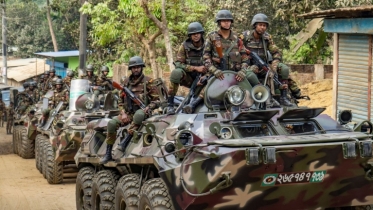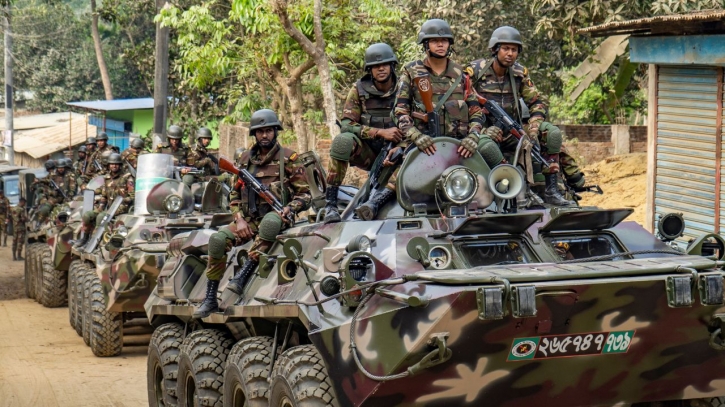
Bangladesh Army APC at Jungle Salimpur raid.
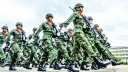
The BNP government has unveiled an ambitious plan to transform Bangladesh’s armed forces into a self-reliant, “four-dimensional” military force, marking a significant shift in the country’s defence and security strategy. This announcement comes just ahead of Prime Minister Tarique Rahman’s upcoming visit to China, an aspiring global power.
Outlined in the 2026-27 national budget document, the initiative also signals a potential rebalancing of resources within the country’s intelligence architecture. The strategy aligns with commitments made in the BNP’s election manifesto ahead of the February national polls. To strengthen local production capacity, the government plans to establish a domestic defence manufacturing industry under the “Made in Bangladesh” banner and build a second Bangladesh Ordnance Factory.
Presenting the budget in parliament on Thursday, Finance Minister Amir Khosru Mahmud Chowdhury proposed a Tk42,500 crore allocation for defence, up from Tk40,500 crore in the current fiscal year. Ultimately, the budget outlines a long-term vision to build self-sufficient, technologically advanced armed forces capable of responding to evolving security challenges.
Manifesto commitments :
The BNP’s election manifesto emphasised the necessity of a modern, professional, and capable military tailored to changing regional and global security realities. It asserted that strong armed forces are essential for safeguarding national sovereignty, maintaining regional stability, and fulfilling Bangladesh’s international obligations. To achieve this, the party pledged to build a “contemporary, four-dimensional armed force” capable of ensuring credible deterrence across land, sea, air, and cyber domains, as well as emerging areas like outer space.
Beyond hardware, the manifesto proposed structural reforms, including establishing a National Security Council, depoliticising the armed forces, and strengthening institutional professionalism. It also committed to developing a self-reliant domestic defence industry to meet military requirements and reduce reliance on foreign suppliers. Aligning with these goals, the budget document outlines that acquiring modern weapons systems, enhancing training, and expanding IT integration will be the core pillars of developing a highly skilled, operationally ready army, navy, and air force.
New intelligence architecture :
The proposed budget signals a notable shift in funding allocations within the country’s intelligence sector. According to budget documents, the proposed allocation for the Directorate General of Forces Intelligence (DGFI) has been reduced to Tk 236 crore, down from Tk 546 crore in the current fiscal year. Conversely, funding for the National Security Intelligence (NSI), which operates under the Prime Minister’s Office, has increased. The proposed budget earmarks Tk 624 crore for the NSI, including its field detachments, up from Tk 540 crore in the current fiscal year. These funding adjustments suggest a potential rebalancing of resources within the country’s intelligence architecture, though the government has not yet publicly elaborated on the rationale behind the revised figures.
Gender inclusion in the armed forces :
The budget highlights the expanding role of women in Bangladesh’s armed forces, noting that more than 2,500 female officers and roughly 3,300 female personnel of other ranks are currently in active service. The military recently achieved a major milestone with the promotion of its first female Major General, reflecting a gradual broadening of leadership opportunities for women. Bangladesh’s commitment to gender inclusion also extends to the global stage. To date, more than 1,700 female military personnel, including 304 officers, have participated in UN peacekeeping missions.
Officials emphasise that this continued focus on diversity is designed to build a more representative, professional military while sustaining the country’s prominent contributions to international peacekeeping operations. Ultimately, the budget outlines a comprehensive defence modernisation agenda. By focusing on military capability development, domestic defence production, institutional reform, and deeper technological integration, the government aims to successfully adapt Bangladesh’s security architecture to emerging global challenges.