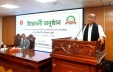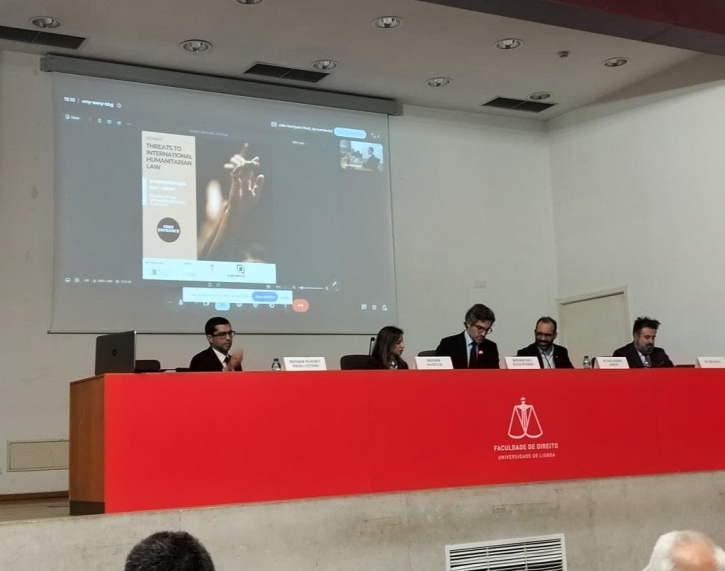
As seen in the photo, the seminar speakers—Professor Francisco Pereira Coutinho, NOVA School of Law, NOVA University of Lisbon; Professor Ana Rita Gil, Faculty of Law, University of Lisbon, speaking on “The Lack of Protection of Displaced Persons in Humanitarian Crises”; Dr João Godinho Martins, Executive Director of Amnesty International–Portugal; and Dr Vasco Malta, Head of Mission for the International Organization for Migration (IOM) in Portugal—are delivering their remarks at the seminar “Threats to International Humanitarian Law.” The session was moderated by Professor Vasco Becker-Weinberg.
Islamic World Observatory, with support from the Faculty of Law, University of Lisbon, organised a seminar titled “Threats to International Humanitarian Law” on 9 November 2026 at the Faculty of Law, University of Lisbon. The event brought together legal scholars, humanitarian practitioners and civil-society representatives to examine the erosion of international humanitarian law (IHL), the protection of displaced persons, and the political and institutional barriers to accountability.
The seminar was opened by Professor Eduardo Vera-Cruz Pinto, Director of the Faculty of Law, University of Lisbon, and Dr João Henriques, Executive President of the Islamic World Observatory. The keynote address was delivered remotely by Professor Alena Douhan, former United Nations Special Rapporteur, followed by a panel discussion moderated by Professor Vasco Becker-Weinberg.
Professor Alena Douhan focused on the relationship between international peace and security, access to information, and unilateral coercive measures. She argued that military action is sometimes justified through appeals to “higher values,” including the protection of human rights, promotion of democracy, or prevention of the proliferation of weapons of mass destruction; however, she maintained that the UN Charter does not permit such justifications to become legal grounds for the use of force.
She also raised concerns about the manipulation of terms such as “disinformation” and “misinformation.” According to Professor Douhan, restrictions on certain media outlets and the framing of information from particular states as harmful can restrict public access to diverse sources of information and may conflict with rights protected under the International Covenant on Civil and Political Rights.
Turning to unilateral coercive measures, she argued that sanctions and over-compliance can produce serious humanitarian consequences. She said such measures may restrict access to food, medicine, education and other essential services, contribute to displacement, and undermine conditions necessary for stability and development.
Professor Francisco Pereira Coutinho of NOVA School of Law examined the weakening of two central IHL principles: distinction and proportionality. He argued that these principles have increasingly been stretched or narrowed in contemporary conflicts, particularly in asymmetrical warfare and situations approaching total war.
He discussed the war in Ukraine, highlighting systematic attacks on civilian infrastructure, including the electricity grid. He stated that such attacks raise serious concerns under IHL, particularly where civilian objects and civilian populations bear the consequences of military operations.
Professor Coutinho also referred to the Gaza conflict and the wider Middle East context. He argued that military and political leaderships must not lower the threshold for the use of force or treat civilian protection as secondary to military objectives. In his view, compliance with IHL cannot depend on whether a party believes its cause is just; the rules governing the conduct of hostilities apply regardless.
He concluded that the erosion of IHL is especially concerning when it occurs among states and militaries that present themselves as defenders of the international legal order. He warned that failure to uphold these standards risks weakening the entire framework of protections developed for wartime.
Professor Ana Rita Gil of the Faculty of Law, University of Lisbon addressed the lack of protection for displaced persons in humanitarian crises. She began by noting that international law is frequently described as failing or even “dead,” but argued that the more urgent question is how its remedies can be strengthened and made effective.
She focused on state responsibility. While acknowledging the role of the International Court of Justice, she explained that enforcement remains a major weakness because implementation often depends on the UN Security Council, where the veto power of permanent members can block action.
Professor Gil also discussed the limits of the international refugee framework. She argued that the refugee definition does not adequately cover all people displaced by war, and that migration-control concerns are too often confused with the protection needs of refugees and displaced persons.
She proposed that states which contribute to a conflict—through training, equipping or otherwise supporting armed actors—should bear heightened responsibility for protecting displaced people and supporting post-conflict reconstruction. Her central argument was that responsibility must extend beyond stopping violations and compensation, to include concrete duties towards victims and displaced populations.
Dr João Godinho Martins, Executive Director of Amnesty International Portugal, examined the political conditions that enable the erosion of IHL. He argued that the problem is not limited to armed groups or states commonly identified as violators, but also involves powerful states and international actors expected to uphold legal standards.
He referred to Amnesty International’s 2026 assessment of the global human-rights situation, which identified political leaders whose actions have contributed to the weakening of IHL. He also argued that many governments, including European states, respond to such violations through appeasement, selective criticism, or the replication of problematic approaches.
Dr Martins highlighted the danger of double standards in international responses to conflicts. He argued that the protection of civilians cannot depend on the nationality of victims, the identity of the perpetrator, or whether a state is an ally, rival or strategic partner.
He further discussed the normalisation of certain conflicts, including Sudan, where mass atrocities and severe human-rights violations receive insufficient political attention. He argued that selective outrage and inconsistent international engagement weaken the universality of IHL and reduce accountability for serious violations.
Dr Vasco Malta, Head of Mission for the International Organization for Migration (IOM) in Portugal, brought the discussion closer to the human consequences of armed conflict. He said IOM works daily with people and families forced to abandon their homes, communities and livelihoods in order to survive.
He asked whether humanitarian law still has practical relevance when hospitals are destroyed, schools attacked, families separated, humanitarian workers killed, and millions displaced. His answer was that the central problem is often not the absence of law, but the lack of political willingness to comply with it.
Referring to the International Committee of the Red Cross principle that “even wars have limits,” Dr Malta stressed that armed conflict does not suspend human dignity. He explained that IHL applies to all parties to a conflict, regardless of the perceived legitimacy of their cause, and that violations by one side do not justify violations by another.
Dr Malta warned against the normalisation of civilian suffering. He noted that images of destroyed neighbourhoods, families searching through rubble, hospitals without medicines and children living in fear risk becoming routine news, while the individuals behind those images remain people with families, futures and rights.
He concluded by focusing on forced displacement, IOM’s core mandate. Citing Internal Displacement Monitoring Centre data, he stated that approximately 82 million people were internally displaced by conflict, violence or disaster at the end of 2025, including around 68 million displaced by conflict and violence. He emphasised that many internally displaced persons remain close to their homes but cannot return because of destruction, landmines, ongoing fighting or the collapse of essential services.
Seminar Outcome
The seminar presented a shared concern: international humanitarian law is under increasing pressure not only because of violations on the battlefield, but also because of political selectivity, weak enforcement, restricted access to information, and the normalisation of civilian suffering.
The speakers agreed that stronger compliance with IHL requires consistent standards, effective accountability, protection for displaced populations, and greater political responsibility from powerful states. The discussion emphasised that humanitarian law must remain a practical shield for civilians, rather than a set of principles applied selectively according to geopolitical interests.
Bangladesh Ambassador to Lisbon Dr. S M Kamrul Hassan Bulbul was present at the seminar among others .