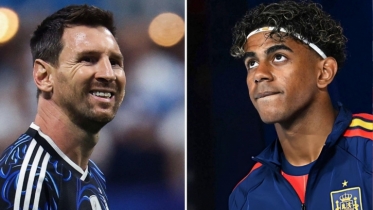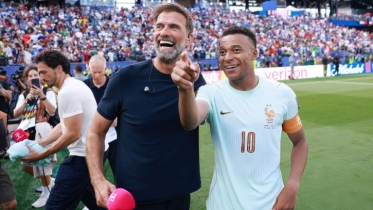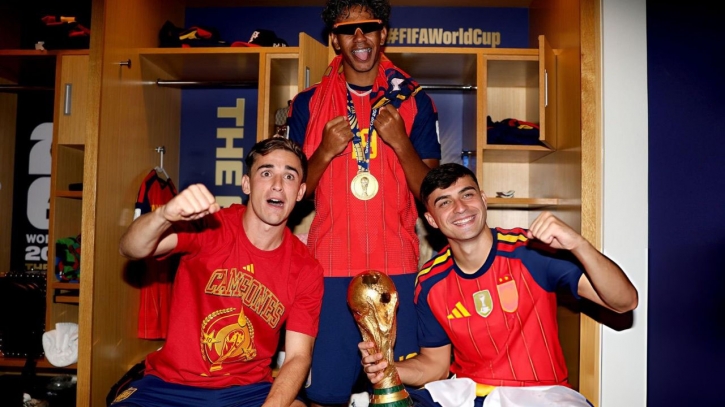
Spain’s Gavi, Lamine Yamal and Pedri celebrate with the FIFA World Cup Winner’s Trophy in the dressing room after the Final match against Argentina at New York New Jersey Stadium.
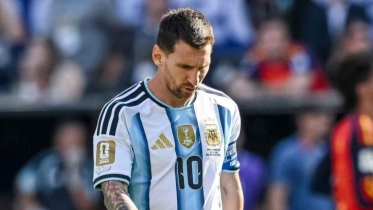
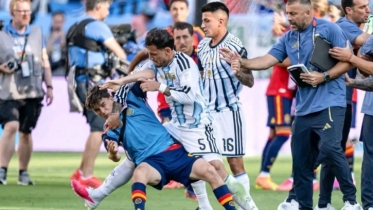
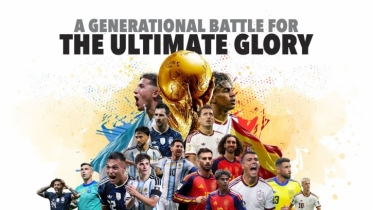
Spain have done it again — and this time, it feels less like a triumph than a statement of intent. La Roja are world champions once more, beating Argentina 1-0 in Sunday’s (Monday BST) final in New Jersey. It is the same trick they pulled off in 2010, arriving two years after a European Championship win — Euro 2008 then, Euro 2024 now. History doesn’t just repeat with Spain. It escalates. This is no longer a golden generation peaking at the right moment. It is a system, deliberately built, now running on autopilot. Spain are the first nation ever to hold the men’s and women’s World Cup simultaneously, with the women having beaten England in the 2023 final in Sydney. Add the men’s 2023 Nations League title, their 2024 Olympic gold, and back-to-back Nations League wins for the women in 2024 and 2025, and the picture becomes staggering: 16 world and European titles across every level, from under-17s to seniors, in just five years.
“It is a dominance,” Spanish football expert Guillem Balague told BBC Sport. “It’s like the perfect storm. Culturally, we do things a certain way. Everybody believes in it. The important thing is that we don’t stop. It’s another Everest because the men won the World Cup in 2010 two years after winning the Euros. Now we’ve done it again.”
The full ledger
Women’s football (11 titles, 2022–2026): one World Cup (2023), two Nations Leagues (2024, 2025), an under-20 World Cup (2022), five straight under-19 European titles (2022–2026), an under-17 World Cup (2022) and under-17 European title (2024).
Men’s football (5 titles, 2022–2026): the 2026 World Cup, the 2024 European Championship, the 2023 Nations League, 2024 Olympic gold at under-23 level, and the 2026 under-19 European title.
The gamble that paid off
When Luis de la Fuente was appointed head coach in December 2022, replacing Luis Enrique after Spain’s last-16 exit to Morocco in Qatar, few expected him to sweep the Nations League, the Euros and the World Cup inside four years.
“They went with this guy who understood the style and the system,” Balague said. “It was a very risky decision — I don’t think anyone thought he would be so successful.” The risk was real: De la Fuente had never managed a top club, spending 15 years instead in lower-league jobs, youth roles and assistant posts before taking charge of Spain’s junior sides.
That grounding is precisely why it worked, according to former midfielder Juan Mata. “De la Fuente knew most of these players from the academies and they are growing as a team. This is not only a team for the present, but also a team for the future.”
De la Fuente himself sounded almost bored by the finish line. “Once we finished the game, there were footballers who said ‘coach, now what else is there to win as we have won everything in all the categories’,” he told reporters in New York. “We came to the conclusion that what remains is the next match in September because this team are relentless.”
Spain are now unbeaten in 38 straight matches across all competitions — the longest run by any European or South American nation on record. And the influence has spread to the club game: roughly a quarter of managers starting the 2026-27 Premier League season are Spanish, even after Pep Guardiola’s decade-long spell at Manchester City ended.
Built from the ground up
The women’s game tells a parallel story of infrastructure catching up to talent. “Ten years ago, when I played for FC Barcelona, there was no La Masia for girls,” former player and journalist Maria Garrido told BBC Sport. “We covered our own transport costs, our parents brought us to training, and we didn’t earn any money. But in the last five years, the situation has improved dramatically… This transformation has not only revolutionised the sport but also elevated the respect for women’s football in Spain.”
Why this is just the start
The youth pipeline is what should worry everyone else. Lamine Yamal and Pau Cubarsi picked up World Cup winners’ medals at 19; Yamal is now the third-youngest World Cup finalist ever, behind only Pele and Giuseppe Bergomi, while he and Cubarsi became the first pair of teenagers to start together in a final. On the women’s side, Vicky Lopez is already a three-time Champions League winner with Barcelona at the same age, and Salma Paralluelo has 50-plus caps before turning 23.
“Spain have got a way of playing that no one in the world has proven they can get anywhere near,” former England goalkeeper Joe Hart said after the final. “No one laid a glove on them at this World Cup — just 10 shots on target against them in the whole tournament.”
1998 World Cup winner Thierry Henry put it most simply: “I want to give credit to the system and what they put in place. Because Spain never used to win like that. And now they win at every level.”