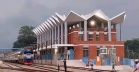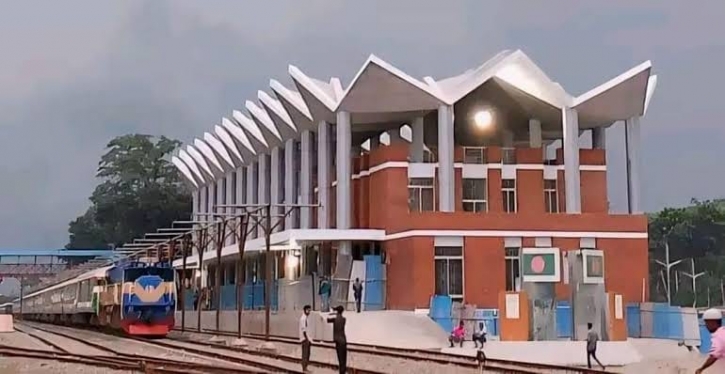
The rail communication between Chilahati, located on the border of Domar Upazila in Nilphamari, and Haldibari in Cooch Behar, India, came to a halt following the 1965 India-Pakistan war. Breaking a 56-year deadlock, this historical route was reopened on August 1, 2021, resuming freight movements. Later, the Dhaka-Siliguri 'Mitali Express' was introduced. To facilitate passenger travel, local residents strongly demanded the establishment of customs and immigration facilities at Chilahati instead of Dhaka. Responding to that demand, an eye-catching iconic station building was constructed at a cost of nearly BDT 130 crore. However, citing incomplete infrastructure, the interim government officially declared all port operations suspended through a notification in August 2025. This single order stalled the momentum of border trade, leaving the fully developed infrastructure—including the high-cost iconic building—completely dysfunctional.
An on-the-spot visit reveals locked-up emptiness. The row of ceiling fans on the ground floor veranda of the iconic building has not rotated in a long time, while packaged furniture covered in dust can be seen through the window gaps. The spaces allocated for customs officials and banks on the second floor remain vacant, and the restaurant area on the third floor is deserted. Padlocks hang on the doors of the second-floor VIP rest house. Due to lack of use, rust is accumulating on the overbridge, platforms, guardrooms, and even the railway track stretching up to the border.
Yet, when the port was operational, this route injected vitality into the local economy. The area bustled with the regular presence of customs agents, workers, and traders, causing land prices to rise as well. The business opportunities that were beginning to unfold have now ground to a halt. Local trader Azizul Islam said, "The cost of transporting goods through Chilahati was lower compared to other ports. Now we have to rely on Burimari and Banglabandha land ports. As these ports are relatively far away, transportation costs have also increased."
Apart from the main building, a massive financial investment was tied to the operationalization of the border rail route. Md. Abdur Rahim, Director of the Bangladesh Railway's Chilahati and Chilahati Border Rail Line Construction Project, stated, "The initial budget for the railway construction was BDT 80 crore, which later rose to BDT 128 crore. The work was completed in June 2024. Including rail wagons, roads, electricity, and allied sectors, the total expenditure reached nearly BDT 200 crore."
With the port at a standstill, the railway department is also missing out on substantial revenue. It has been learned that each consignment of stone-laden trains generated BDT 20 to 26 lakh for the railways. With an average of four to five freight trains running per month, the monthly revenue reached BDT 1 to 1.5 crore. Providing details of the earnings, Assistant Station Master of Chilahati Station, Ismail Hossain, said, "From 2021 onwards, trains mostly loaded with stones used to arrive from India. Four to five freight trains operated every month. Between 2021 and 2024, the railways earned approximately BDT 13 crore. Following the political transition, both freight and passenger train services came to a complete stop."
Regarding future steps, Deputy Commissioner Mohammad Nayiruzzaman stated, "The potential of the Chilahati land port has been communicated to the relevant ministry. This is a matter of high-level government decision. We hope the port will resume operations in the future."
To protect national assets worth billions from abandonment and to end regional economic stagnation, the people of Chilahati earnestly appeal for a reconsideration of the government notification and the swift reopening of the port.