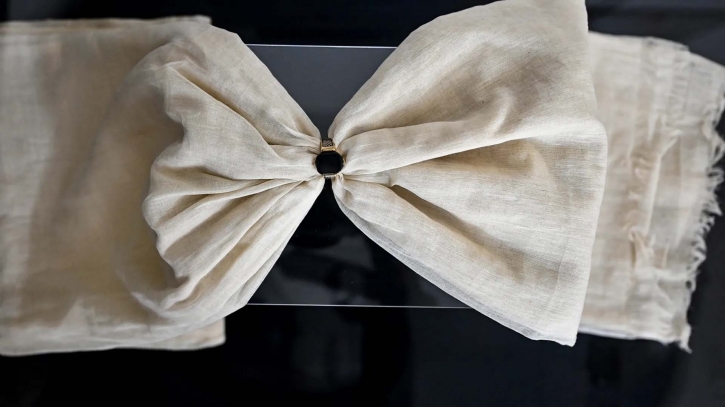
The legendary 'Woven Air'- Dhakai Muslin- has returned from the pages of fairy tales into reality, thanks to the visionary initiative of the government, relentless genome research by scientists, and the magic of marginal women artisans' fingers.
The traditional ‘Dhakai Muslin’, which is famous for its exceptionally delicate cotton weave, now fully prepared to spread its wings in the global market commercially, following the restoration of the ancient thread-making technology and the raw material.
The ‘Dhakai Muslin’, as transparent as a shred of white cloud, as serene as morning dew, and as light as a thread floating in the air, was acclaimed as a top global luxury brand in the Roman, Greek, and Arab empires since 500 BC. During the Mughal era, its prestige reached such a pinnacle that the finest version of Muslin, 'Malmal Khas', was exclusively reserved for emperors.
Depending on the design and quality, Muslin—the artistic pride and ultimate excellence of Bengali weaving—had various poetic names such as 'Ab-e-Rawan' (flowing water) and 'Shabnam' (morning dew). The historic accounts of an entire saree easily fitting inside a matchbox or passing through a small ring bear testament to the unimaginable fineness of Muslin.
Around 170 years ago, towards the end of the 18th century, the aggression of cheap mill-made fabrics from Manchester by the British East India Company, horrific physical torture on local weavers (such as severing their thumbs), and the imposition of punitive taxes choked the life out of this industry.
Furthermore, the unique raw material required for Muslin—the 'Phuti Karpas' cotton plant grown exclusively in the Meghna river basin—eventually went completely extinct from nature, putting the final nail in the coffin of the industry. The original ‘Dhakai Muslin’ was exhibited for the last time at the Great Exhibition in London in 1850, after which it became mere history.
Weaving Dhakai Muslin was not just ordinary manual labour; it was a complex folk science intertwined with weather conditions. The ultra-fine thread of ‘Phuti Karpas’ tends to snap in dry air. Therefore, the early morning hours before sunrise and the humid atmosphere of the evening were chosen for spinning Muslin thread.
The natural humidity and temperature of the Shitalakshya river basin, in particular, were a unique blessing of nature for spinning this thread.
A genuine ‘Dhakai Muslin’ was crafted only after passing through 16 precise and rigorous steps, including harvesting cotton from the field, separating fibers, cleaning cotton with the jawbones of Boal fish, spinning thread on ultra-fine takli and spindles, washing the thread, and weaving on specialized looms with distinct designs.
In 2014, the Bangladesh Handloom Board formed a high-level research team to restore Muslin. The long journey of the research team was as thrilling as a scientific thriller novel. Guided by historical records and sketches from a 1788 book by Swedish scientist Carl Linnaeus, researchers collected 39 wild cotton varieties from Kapasia, Gazipur, Baghabari, and Rajshahi regions.
By performing DNA sequencing and genome matching of the collected cotton with the original Muslin thread samples preserved at the Victoria and Albert Museum in London, 100% authentic 'Phuti Karpas' was finally identified and cultivated.
More than 50 traditional specialized tools had to be remade to weave Muslin. While the thread count of ordinary cotton fabrics ranges between 40 and 80, the thread of the revived ‘Dhakai Muslin’ has exceeded 731 to 750 metric counts, giving the fabric a dew-like transparency.
In December 2020, ‘Dhakai Muslin’ achieved the Geographical Indication (GI) status for Bangladesh, securing its exclusive ownership and rights in the international arena.
Muslin is now transforming from a laboratory or exhibition object into a living commercial industry. Following the success of the first phase, the government is currently implementing the second phase of the project worth Taka 18.5 crore (185 million BDT).
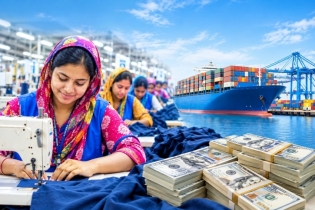
The most significant social aspect of this project is that more than 300 marginal women have been meticulously trained to spin this ultra-fine thread, transforming them into skilled spinners who are bringing about a revolutionary change in the rural economy.
Luxury brands from major countries such as the United States, France, and Japan have shown keen interest in purchasing this revived ‘Dhakai Muslin’. Meanwhile, a major international order for 500 yards of Muslin fabric has already been successfully completed.
Centring the 'Dhakai Muslin House' built in Tarabo of Rupganj, Narayanganj, the process of transferring this technology to private sector entrepreneurs is progressing rapidly.
Recently, the further improvement of the ‘Phuti Karpas’ variety was announced at a seminar organized by the Ministry of Textiles and Jute. To prevent any shortage of raw materials, contract farming arrangements are being established with rural farmers in Kapasia, Rajshahi, and Cumilla.
Although the production cost of a saree was Taka 3.60 lakh initially, efforts are underway to bring it down between Taka one lakh and three lakhs through mass production. Crafting a sophisticated Muslin saree takes several months of labour by two to four weavers.
Thus, it will primarily establish itself as a premium luxury fashion item for elites in the global market. The commercial production will lead Bangladesh into a unique height in the high-end international luxury export sector, beyond the traditional ready-made garments industry.
Although the production cost is high in the initial stages of commercial production, plans are in place to bring the market price of the saree within the reach of the general public once the technology is transferred to the private sector and large-scale cultivation begins.