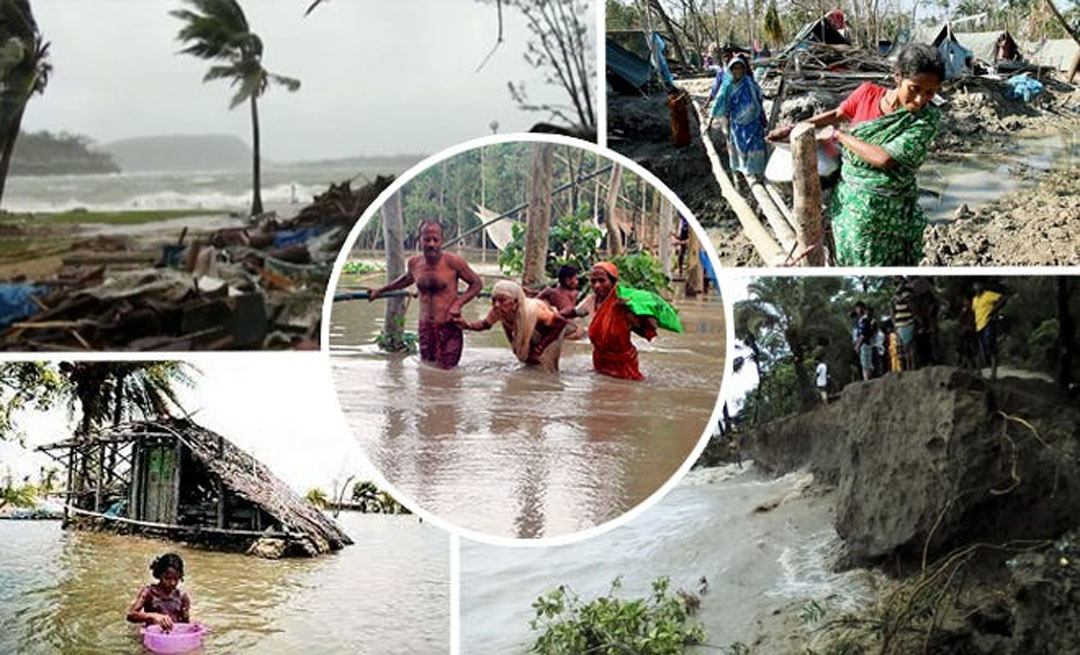
Bangladesh is rated as ‘very high risk’ on the 2024 index.
"The World Risk Report 2024 - Focus: Multiple Crises" was published jointly by the Institute for International Law of Peace and Armed Conflict (IFHV) of the Ruhr-University Bochum and an alliance of nine German development organisations, Bündnis Entwicklung Hilft.
For the third consecutive year, Bangladesh has been identified as the ninth most natural disaster risk country in the world, owing to a combination of diverse exposures, high intensities, and higher vulnerabilities
The report covers the disaster risk from extreme natural events and negative climate change impacts for all 193 United Nations member states and more than 99% of the world's population.
Bangladesh is rated as 'very high risk' on the 2024 index, with a score of 27.73 out of 100, up from 27.29 in 2023. Any score above 12.89 indicates 'very high risk.'
The technical report highlighted the risk hotspots remain in the Americas and Asia, as can be seen in the group of ten countries with the highest risk scores: The Philippines, Indonesia, India, Colombia, Mexico, Myanmar, Mozambique, Russia, Bangladesh, and Pakistan.
"However, as climate change increases the frequency and intensity of extreme weather events, these global hotspots are anticipated to shift, affecting vulnerable societies in Africa in particular," reads the report.
The risk assessment is based on the general notion that the emergence of a disaster depends not only on how severely natural hazards strike a society but also on how vulnerable the society is to its effects. The index is calculated per country as the geometric mean of exposure and vulnerability.
Exposure represents the extent to which populations are exposed to and burdened by the impacts of earthquakes, tsunamis, coastal and riverine flooding, cyclones, droughts, and sea level rise. Bangladesh scored 16.57 in this indicator.
The country scored 46.39 in vulnerability which maps the societal domain and is composed of three dimensions—susceptibility, coping and adaptation.
Susceptibility is dependent on the level of socio-economic development, social disparities, deprivations, and vulnerable population groups. The country scored 35.50 in this segment.
The country scored 57.92 in lack of coping capacities which is dependent on social shocks, political stability and the rule of law, health care capacities, infrastructure, and material protection.
Lack of adaptive capacities is related to developments in education and research, reduction of disparities, investments, disaster prevention, and climate protection. The country scored 48.54 in this segment.